Monday, May 16, 2022

Kevlar broken samples from dynamic stabbing zoomed in

 Microscopic Mondays!


Kevlar broken samples from dynamic stabbing zoomed in!


Research project "Dynamic/quasi-static stab-resistance and mechanical properties of soft body armor composites constructed from Kevlar fabrics and shear thickening fluids" published by Jianbin Qin, Guangcheng Zhang, Lisheng Zhou, Jiantong Li, and Xuetao Shi, investigated how different quantities of shear thickening fluid (STF) affect the knife-stabbing resistance and the quasi-static mechanical properties of kevlar composite samples.


This collage shows photographs and SEM images of broken samples from the dynamic stabbing tests. (a), (d), (g) and (j) are the neat Kevlar fabric; (b), (e), (h) and (k) are the composite with 36.23 wt% STF; (c), (f), (i) and (l) are the composite with 103.79 wt% STF.


The results show that the shear thickening fluid positively influenced the properties of the samples!


Source:#managingcomposites


Friday, May 13, 2022

LITHIUM ION BATTERY

 Do we need to depend on Lithium-ion batteries for Electric vehicles for a decade or more?

Climate changes have happened rapidly throughout many regions in the recent decade. On one side the deforestation takes place steadily in many regions and the natural resources are draining out a lot. Each country is losing its share of forest land every year drastically.

On the other side, the sudden interest among Electric vehicle manufacturers made the world depend on lithium-ion batteries more than expected a decade ago.


Some EV manufacturers are holding licenses for such minerals in the US for the lithium extraction for the Lithium Iron Phosphate battery cells. The world needs many materials for the production of an EV battery. Mining and deforestation happen at the same time everywhere that is not safe for the environment that we humans aim to create for future generations.

Mining at depth will make the earth weakening as well as the water gets toxic too. Toxic rain will be the result.


Don't we have any other alternative?

Magnesium-based and sodium ion-based batteries the EV manufacturers can aim for the progress in that line.


Mining project numbers are increasing and the largest corporations aiming to mint the money in the name of an alternate vehicle market. There is a strict and combined regulation the Energy associations must create as early as possible to avoid the blame game of each technology.


The more we destroy our soil and trees, the more we get unhealthy in the coming days, which is not a good sign for a healthy environment. We should not switch all of a sudden on one technology that seems to create more pain for humans in the days to come. China is supplying most of the minerals to the EV battery manufacturers today and the country is losing its beauty so we shouldn't forget it.


Despite depending on Electric vehicles, it is time to invest in more sustainable projects such as Green Hydrogen/Solid Hydrogen/Green Ammonia/LNG/Methanol, etc for a better alternate fuel market.

It is time to think about our future than the present comfortable life.


Let's hear the workable road map on this topic. Share your comments if possible so that we can make a better world for sure.


Muthuramalingam Krishnan

Wednesday, May 11, 2022

BASF Introduces Color-stable FR Polyamide for e-Mobility:

  With Ultramid® A3U44G6 DC OR (PA66 - GF30 FR), BASF is expanding its portfolio of flame-retardant engineering plastics for the e-Mobility market. High technical requirements from the industry require innovative solutions based on PA66. In the case of already proven Ultradur® (PBT) products, color stability can be largely guaranteed, especially in orange (RAL 2003) which is in high demand in the industry. Conventional polyamides, however, tend to have strong color fluctuations or yellowing during heat aging.


"High-voltage components are usually exposed to significant temperature fluctuations. This repeatedly leads to strong discoloration in conventional polyamides. Our newly developed type Ultramid® A3U44G6 DC OR closes the innovation gap in terms of color stability and mechanical strength", explains Tina Weller, Product Development BASF. For the first time, the new grade meets all the criteria of color stability and heat aging resistance and thus also enables long-lasting color coding, which is safety-relevant in the sensitive area of high voltages. The color stability could be confirmed after 1.000h at up to 130°C in the test.


High Electrical Insulation and Fire Protection:


In addition to the color consistency, Ultramid® A3U44G6 DC OR with a CTI 600 is characterized by high electrical insulation. The use of tailor-made pigments while at the same time dispensing with halide-containing flame retardants also counteracts electro-corrosion, which was previously difficult to contain, especially in humid and warm environments.


"During development, we focused on the elimination of halides such as iodide and bromide, thus setting the course for a durable product without contact corrosion," explains Michael Roth, product development BASF.


With a very low total halide content (less than 50ppm), the PA66 achieves fire protection class UL94 V0 at 0.4mm. Furthermore, the product is equipped with a special organic heat stabilization package to meet the technical market requirements.


Source: BASF/OMNEXUS SPECIALCHEM


Tuesday, May 10, 2022

Global GDP 2021

 Global GDP is $94 Trillion. Visualizing the $94 Trillion World 

How do you foresee the GDP numbers of Europe/China/Japan/India/the US in the next 5 years?
 
Source: Visual Capitalist.


Monday, May 9, 2022

Feds Funding Research On Role Of Cannabis In Treating Cancer

 The federal government is promoting funding opportunities for researchers to study the benefits and risks of marijuana for cancer patients.

In a notice of special interest posted by the National Institutes of Health (NIH) on Thursday, the agency said that about one in four cancer patients have reported using cannabis products to manage their symptoms—including anorexia, nausea, and pain—but “research about their health effects, including potential harms and benefits, remain limited.”


NIH’s National Cancer Institute said that the purpose of the solicitation is to “promote research in understanding the mechanisms by which cannabis and cannabinoids affect cancer biology, cancer interception, cancer treatment and resistance, and management of cancer symptoms.”


It provided an overview of the existing research into the relationship between marijuana and cancer, as well as a list of eight areas of interest that the agency is asking researchers to investigate.

NIH said that the current body of epidemiological studies on this topic has “yielded limited and inconsistent results.” For example, while cannabis smoke may contain harmful constituents, it hasn’t been directly linked to an increased risk of lung cancer, the notice says.

The agency said, “studies of other cancer types have shown no or inconsistent association with cannabis use, but these data are limited.”

The compounds in marijuana affect the endocannabinoid system, which plays a role in modulating “many cancer-relevant processes, such as cell proliferation, motility, and survival,” the notice says.

“Cancer cell line experiments show that THC and CBD can mediate many anti-tumor effects, including inducing apoptosis and inhibiting cell proliferation, invasion, and angiogenesis,” it continues. “These anti-tumor activities have led to early clinical testing of THC and CBD for glioblastoma and prostate cancers.”


While NIH isn’t taking a position on the validity of past studies, it’s notable that the federal agency is recognizing where there might be therapeutic value in cannabis for the serious illness, especially considering that marijuana remains a prohibited Schedule I drug in large part because the government maintains that it has no legitimate medical use.


Here’s a list of research topics that NIH is seeking studies on with various funding opportunities: 

Understanding how exogenous cannabis and cannabinoids affect cancer development (preneoplasia through malignancy) and biology, including the tumor microenvironment;

Understanding how endogenous cannabinoid pathways influence cancer development and biology;

Defining the effects of cannabis and cannabinoids on cancer treatment (particularly targeted treatments and immunotherapy) and the development of treatment resistance;

  • Understanding the use of cannabis and cannabinoids in cancer interception and delineating how endocannabinoid signaling pathways may inhibit early cancers;
  • Defining the mechanisms of cannabis and cannabinoid action in alleviating symptoms of cancer and cancer treatment (such as pain, nausea, and neuropathy);
  • Understanding the combinatorial effects of cannabis and cannabinoids in conjunction with other factors (such as tobacco constituents, alcohol, microbiome, or diet) on cancer biology, treatment, and symptom management;
  • Identifying biological mechanisms underlying disparities in sex or ethnicity in cannabis and cannabinoid action in cancer biology, treatment, or symptom management; and
  • Developing or validating new and human-relevant model systems to understand cannabis and cannabinoid action in cancer biology, treatment, or symptom management.

The notice states that the list is just a guideline, however, and researchers are invited to propose other research objectives within the basic framework.

Source:marijuanamoment.net


LG Chem develops advanced plastic materials that prevent battery’s thermal runaway

Compared to conventional plastics, the new material has an excellent heat resistance with the longest flame blocking duration in the world.
In-house test results show that the material prevented flame propagation for over 400 seconds above 1,000 degrees
Helps secure the time required for evacuating drivers and suppressing fire.


The mass-production system is fully established, beginning a full-scale production starting 2023

The material will be applied to various industries based on the supply of battery pack covers

Steven Kim (Senior VicePresident/ Division Leader, Engineering Materials Division. Advanced Materials),“Continued research for over a decade to solve our customer’s pain points have turned out to be tremendously meaningful.”
“Based on the world’s best compounding technology, LG Chem plans to continue its R&D and invest in mass production to lead a fast-growing e-Mobility market.”
 
LG Chem plans to target the market with its recent development of battery pack plastic materials that can delay the thermal runaway of electric vehicle batteries for the longest period in the world.

With its own technology and manufacturing methods, LG Chem announced that it developed flame-retardant engineering plastic material that prevents deformation by heat.

Thermal runaway, the main cause of fire in electric vehicle batteries, is a phenomenon where battery cell suffers stresses from various origins and heats up subsequently. Flames arise once the battery’s internal temperature rises above a certain level due to short circuits such as overvoltage and over-discharge. The lithium-ion battery has high reactivity to water, which makes it difficult to extinguish it with water in case of fire.

LG Chem’s newly developed special flame retardant is a high-functional engineering plastic material that consists of various material groups such as polyphenylene oxide (PPO), polyamide (PA), and polybutylene terephthalate (PBT).

Compared to general flame-retardant plastics, the new material can block heat for a longer period when it is applied to an electric vehicle’s battery pack cover thanks to its excellent heat resistance. The material also has superb dimensional stability that can continue to maintain its shape despite temperature changes. According to LG Chem’s in-house test results, the material can block flame propagation caused by thermal runaway for more than 400 seconds at 1,000 degrees. This is 45 times better than general flame-retardant plastics.

LG Chem’s new engineering plastic material can be applied to battery pack covers so that it can delay the combustion period in case of fire and prevent the flame from spreading. This will help secure the time needed to evacuate drivers and put out a fire.

Source: LG CHEM


Saturday, May 7, 2022

U.K. team successfully recycles reclaimed continuous carbon fibers from pressure tanks

 The U.K.’s NCC with partners B&M Longworth and Cygnet Texkimp achieve continuous carbon fiber recovery in a significant first step to delivering sustainable composite pressure vessels for the hydrogen market.  

Engineers at the National Composites Centre (Bristol, U.K.), the U.K.’s center of excellence for advanced composite applications, along with British SME partners B&M Longworth (Edgworth, U.K.) and Cygnet Texkimp (Northwich, Cheshire, U.K.), have successfully reclaimed continuous carbon fibers from a whole pressure vessel and re-used them to manufacture a new pressure vessel. This is reported to be the first time this process has been achieved in the U.K. and represents a significant milestone in the development of Britain’s hydrogen capability. 
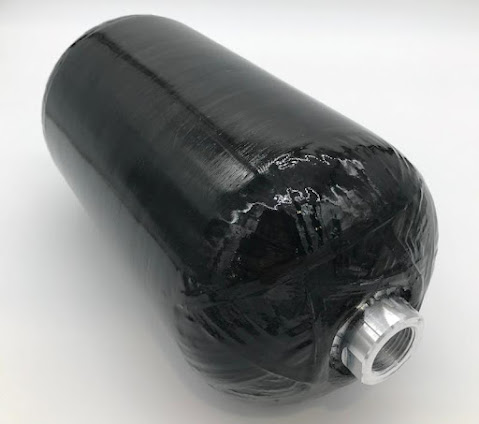


As hydrogen has low energy density, the NCC says, it needs to be compressed and stored at very high pressures, between 350-700 bar (5,076-10,152 psi).  This makes high-strength, lower-weight carbon fiber the material of choice, especially for hydrogen pressure vessels in vehicles such as cars or aircraft, where power-to-weight is critical. Demand for carbon fiber, however, is expected to grow five-fold between 2025 and 2030, exceeding global manufacturing capacity. Creating viable, low-cost recovery processes, that retain the inherent strength of continuous carbon fibers for recycling, is therefore key to the development of the hydrogen economy.

According to the NCC, until recently, recycling processes for composite components such as aircraft wings and wind turbine blades have resulted in short fibers with lower mechanical properties than virgin fiber. While there are applications for this material, it is not suitable for re-use in high-performing products.

Partnering with B&M Longworth, the NCC team successfully reclaimed continuous carbon fiber from end-of-life (EOL) composite pressure tanks, using the company’s revolutionary DEECOM process (see “Pressurized steam-based composites recycling for full fiber reclamation”). Originally designed to remove waste polymers from filters and production equipment, the process uses superheated steam, under compression, to penetrate microscopic fissures in the composite’s polymer, where it then condenses. On decompression, it boils and expands, cracking the polymer and carrying away broken particles. This pressure swing cycle is then repeated until all the matrix (the material suspended in the polymer) has been separated from the fiber, enabling the monomers to also be reclaimed for possible reprocessing. 

Crucially, the NCC says, the DEECOM process leaves the primary component material intact and undamaged, enabling for any length to be retained.  As a result, NCC engineers working with Cygnet Texkimp could use the reclaimed continuous carbon fiber to make a new pressure vessel using filament winding.

The partnership is now looking to work with manufacturers to scale and industrialize this process, sharing the knowledge of recent recycling trials. The next step is to undertake fiber characterization analysis of the reclaimed material and recycled vessel, as the team works towards their ultimate goal: developing the disruptive technologies that enable sustainable hydrogen storage solutions.

“Achieving continuous fiber recovery is a significant step towards our goal of a fully recyclable certified tank — the critical technology barrier we need to address if we are to embed hydrogen in our energy mix and meet net-zero targets,” Marcus Walls-Bruck, chief engineer, hydrogen, NCC says. The project results will be announced at JEC World this week. “We are at the stage of being able to share this expertise in fiber recovery and our extensive design exploration work for composite pressure vessels. We want to hear from companies interested in joining us on this journey to sustainable pressure vessels as we accelerate U.K. capabilities.”

The fiber recovery and recycling project form part of the NCC’s hydrogen program, developing and sharing the technical knowledge, cross-sector composite expertise, and state-of-the-art technology that businesses need to achieve their hydrogen ambitions.

As part of this program, NCC engineers have worked to refine composite pressure vessel designs, producing detailed design and analysis to minimize waste and trial the tools and manufacturing processes the industry will use to reclaim and recycle continuous carbon fibers. They have also reportedly delivered composite design specifications for cryogenic pressure vessels and are working on a certification pathway for composite pressure pipes, including those to be used offshore.

“Following intensive R&D into the use of DEECOM for composite reclamation and circularity, we’re excited to see successful reclamation and remanufacture of a pressure tank,” Jen Hill, director, B&M Longworth Ltd., says. “Recent projects have seen success in a range of composite panels and automotive parts, so a move towards hydrogen tanks was the next logical challenge. Thanks to insight from experts at the National Composites Centre, along with the expertise of our partners at Cygnet Texkimp, we’ve achieved what several said was impossible and are already progressing to the testing stage and looking for the next challenge.”

“One of the most exciting aspects of this collaboration and the technologies it is built around is the way in which we are able to maximize the value and integrity of the fiber at every stage in the process,” Luke Vardy, CEO, Cygnet Texkimp adds. “Not only does this technology have the potential to transform EOL outcomes for composites, but it also shows how we can do so without compromising the essential properties of the fiber. That commitment to fiber integrity is significant because it allows us to reclaim and repurpose carbon fiber in a way that is reliable and sustainable, while creating end products of the highest quality and consistency.”

Source:compositesworld

Photo Credit: National Composites Centre (NCC)

The BIOVALSA project: making bioplastics from agricultural waste and pruning residues

Every year, the Valencian agricultural sector generates around 800 000 tons of plant waste, such as rice straw and citrus pruning waste. The...