Monday, May 9, 2022

LG Chem develops advanced plastic materials that prevent battery’s thermal runaway

Compared to conventional plastics, the new material has an excellent heat resistance with the longest flame blocking duration in the world.
In-house test results show that the material prevented flame propagation for over 400 seconds above 1,000 degrees
Helps secure the time required for evacuating drivers and suppressing fire.


The mass-production system is fully established, beginning a full-scale production starting 2023

The material will be applied to various industries based on the supply of battery pack covers

Steven Kim (Senior VicePresident/ Division Leader, Engineering Materials Division. Advanced Materials),“Continued research for over a decade to solve our customer’s pain points have turned out to be tremendously meaningful.”
“Based on the world’s best compounding technology, LG Chem plans to continue its R&D and invest in mass production to lead a fast-growing e-Mobility market.”
 
LG Chem plans to target the market with its recent development of battery pack plastic materials that can delay the thermal runaway of electric vehicle batteries for the longest period in the world.

With its own technology and manufacturing methods, LG Chem announced that it developed flame-retardant engineering plastic material that prevents deformation by heat.

Thermal runaway, the main cause of fire in electric vehicle batteries, is a phenomenon where battery cell suffers stresses from various origins and heats up subsequently. Flames arise once the battery’s internal temperature rises above a certain level due to short circuits such as overvoltage and over-discharge. The lithium-ion battery has high reactivity to water, which makes it difficult to extinguish it with water in case of fire.

LG Chem’s newly developed special flame retardant is a high-functional engineering plastic material that consists of various material groups such as polyphenylene oxide (PPO), polyamide (PA), and polybutylene terephthalate (PBT).

Compared to general flame-retardant plastics, the new material can block heat for a longer period when it is applied to an electric vehicle’s battery pack cover thanks to its excellent heat resistance. The material also has superb dimensional stability that can continue to maintain its shape despite temperature changes. According to LG Chem’s in-house test results, the material can block flame propagation caused by thermal runaway for more than 400 seconds at 1,000 degrees. This is 45 times better than general flame-retardant plastics.

LG Chem’s new engineering plastic material can be applied to battery pack covers so that it can delay the combustion period in case of fire and prevent the flame from spreading. This will help secure the time needed to evacuate drivers and put out a fire.

Source: LG CHEM


Saturday, May 7, 2022

U.K. team successfully recycles reclaimed continuous carbon fibers from pressure tanks

 The U.K.’s NCC with partners B&M Longworth and Cygnet Texkimp achieve continuous carbon fiber recovery in a significant first step to delivering sustainable composite pressure vessels for the hydrogen market.  

Engineers at the National Composites Centre (Bristol, U.K.), the U.K.’s center of excellence for advanced composite applications, along with British SME partners B&M Longworth (Edgworth, U.K.) and Cygnet Texkimp (Northwich, Cheshire, U.K.), have successfully reclaimed continuous carbon fibers from a whole pressure vessel and re-used them to manufacture a new pressure vessel. This is reported to be the first time this process has been achieved in the U.K. and represents a significant milestone in the development of Britain’s hydrogen capability. 
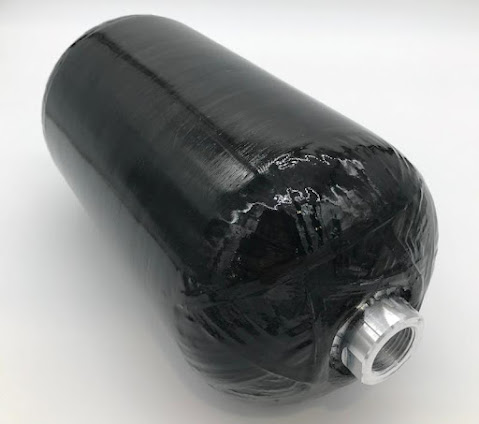


As hydrogen has low energy density, the NCC says, it needs to be compressed and stored at very high pressures, between 350-700 bar (5,076-10,152 psi).  This makes high-strength, lower-weight carbon fiber the material of choice, especially for hydrogen pressure vessels in vehicles such as cars or aircraft, where power-to-weight is critical. Demand for carbon fiber, however, is expected to grow five-fold between 2025 and 2030, exceeding global manufacturing capacity. Creating viable, low-cost recovery processes, that retain the inherent strength of continuous carbon fibers for recycling, is therefore key to the development of the hydrogen economy.

According to the NCC, until recently, recycling processes for composite components such as aircraft wings and wind turbine blades have resulted in short fibers with lower mechanical properties than virgin fiber. While there are applications for this material, it is not suitable for re-use in high-performing products.

Partnering with B&M Longworth, the NCC team successfully reclaimed continuous carbon fiber from end-of-life (EOL) composite pressure tanks, using the company’s revolutionary DEECOM process (see “Pressurized steam-based composites recycling for full fiber reclamation”). Originally designed to remove waste polymers from filters and production equipment, the process uses superheated steam, under compression, to penetrate microscopic fissures in the composite’s polymer, where it then condenses. On decompression, it boils and expands, cracking the polymer and carrying away broken particles. This pressure swing cycle is then repeated until all the matrix (the material suspended in the polymer) has been separated from the fiber, enabling the monomers to also be reclaimed for possible reprocessing. 

Crucially, the NCC says, the DEECOM process leaves the primary component material intact and undamaged, enabling for any length to be retained.  As a result, NCC engineers working with Cygnet Texkimp could use the reclaimed continuous carbon fiber to make a new pressure vessel using filament winding.

The partnership is now looking to work with manufacturers to scale and industrialize this process, sharing the knowledge of recent recycling trials. The next step is to undertake fiber characterization analysis of the reclaimed material and recycled vessel, as the team works towards their ultimate goal: developing the disruptive technologies that enable sustainable hydrogen storage solutions.

“Achieving continuous fiber recovery is a significant step towards our goal of a fully recyclable certified tank — the critical technology barrier we need to address if we are to embed hydrogen in our energy mix and meet net-zero targets,” Marcus Walls-Bruck, chief engineer, hydrogen, NCC says. The project results will be announced at JEC World this week. “We are at the stage of being able to share this expertise in fiber recovery and our extensive design exploration work for composite pressure vessels. We want to hear from companies interested in joining us on this journey to sustainable pressure vessels as we accelerate U.K. capabilities.”

The fiber recovery and recycling project form part of the NCC’s hydrogen program, developing and sharing the technical knowledge, cross-sector composite expertise, and state-of-the-art technology that businesses need to achieve their hydrogen ambitions.

As part of this program, NCC engineers have worked to refine composite pressure vessel designs, producing detailed design and analysis to minimize waste and trial the tools and manufacturing processes the industry will use to reclaim and recycle continuous carbon fibers. They have also reportedly delivered composite design specifications for cryogenic pressure vessels and are working on a certification pathway for composite pressure pipes, including those to be used offshore.

“Following intensive R&D into the use of DEECOM for composite reclamation and circularity, we’re excited to see successful reclamation and remanufacture of a pressure tank,” Jen Hill, director, B&M Longworth Ltd., says. “Recent projects have seen success in a range of composite panels and automotive parts, so a move towards hydrogen tanks was the next logical challenge. Thanks to insight from experts at the National Composites Centre, along with the expertise of our partners at Cygnet Texkimp, we’ve achieved what several said was impossible and are already progressing to the testing stage and looking for the next challenge.”

“One of the most exciting aspects of this collaboration and the technologies it is built around is the way in which we are able to maximize the value and integrity of the fiber at every stage in the process,” Luke Vardy, CEO, Cygnet Texkimp adds. “Not only does this technology have the potential to transform EOL outcomes for composites, but it also shows how we can do so without compromising the essential properties of the fiber. That commitment to fiber integrity is significant because it allows us to reclaim and repurpose carbon fiber in a way that is reliable and sustainable, while creating end products of the highest quality and consistency.”

Source:compositesworld

Photo Credit: National Composites Centre (NCC)

Dunning-Kruger effect

Dunning-Kruger effect:
People with low ability tend to overestimate themselves. On the other hand, high performers have a tendency to underestimate their skills.

Overcoming the Dunning-Kruger effect
Take time to reflect. Some people feel more confident when they make decisions quickly, but snap decisions can lead to errors of judgment. ...
See learning as a way forward. ...
Challenge your own beliefs. ...
Change your reasoning. ...
Learn from feedback.

Beware of this effect when you are starting a new business.


Friday, May 6, 2022

Tomorrow's Scientists: How is the global talent pool changing?

 The World Economic Forum reported that #China had 4.7 million recent STEM (science, technology, engineering, and math) graduates in 2016. #India, another academic powerhouse, had 2.6 million new #STEM graduates while the U.S. had 568,000. Chinese STEM graduates outnumber US STEM grads 8.2 to 1.

The gap is going to become even wider. Even modest predictions see the number of 25 to 34-year-old graduates in China rising by a further 300% by 2030, compared with an increase of around 30% expected in #Europe and the #UnitedStates.


By 2030, China and India could account for more than 60% of the STEM graduates in major economies, compared with only 8% in Europe and 4% in the United States.


China has been building the equivalent of almost one university per week.


For decades, the United States had the highest proportion of people going to university and dominated the graduate market.


https://lnkd.in/enMe9zMw

 from the "Human Capital Report 2016" by WEF


The search reveals eight new sources of black hole echoes

Scattered across our Milky Way galaxy are tens of millions of black holes — immensely strong gravitational wells of spacetime, from which infalling matter, and even light, can never escape. Black holes are dark by definition, except on rare occasions when they feed. As a black hole pulls in gas and dust from an orbiting star, it can give off spectacular bursts of X-ray light that bounce and echo off the inspiraling gas, briefly illuminating a black hole’s extreme surroundings.


Now MIT astronomers are looking for flashes and echoes from nearby black hole X-ray binaries — systems with a star orbiting, and occasionally being eaten away by a black hole. They are analyzing the echoes from such systems to reconstruct a black hole’s immediate, extreme vicinity.


In a study appearing today in the Astrophysical Journal, the researchers report using a new automated search tool, which they’ve coined the “Reverberation Machine,” to comb through satellite data for signs of black hole echoes. In their search, they have discovered eight new echoing black hole binaries in our galaxy. Previously, only two such systems in the Milky Way were known to emit X-ray echoes.


In comparing the echoes across systems, the team has pieced together a general picture of how a black hole evolves during an outburst. Across all systems, they observed that a black hole first undergoes a “hard” state, whipping up a corona of high-energy photons along with a jet of relativistic particles that are launched away at close to the speed of light. The researchers discovered that at a certain point, the black hole gives off one final, high-energy flash, before transitioning to a “soft,” low-energy state.


This final flash may be a sign that a black hole’s corona, the region of high-energy plasma just outside a black hole’s boundary, briefly expands, ejecting a final burst of high-energy particles before disappearing entirely. These findings could help to explain how larger, supermassive black holes at the center of a galaxy can eject particles across vastly cosmic scales to shape a galaxy’s formation.


“The role of black holes in galaxy evolution is an outstanding question in modern astrophysics,” says Erin Kara, assistant professor of physics at MIT. “Interestingly, these black hole binaries appear to be ‘mini’ supermassive black holes, and so by understanding the outbursts in these small, nearby systems, we can understand how similar outbursts in supermassive black holes affect the galaxies in which they reside.”


Source:MIT


Tuesday, May 3, 2022

THE KEY MINERALS IN AN EV BATTERY

 THE KEY MINERALS IN AN EV BATTERY


The EV battery market is still in its early hours, with plenty of growth on the horizon. Battery chemistries are constantly evolving, and as automakers come up with new models with different characteristics, it’ll be interesting to see which new cathodes come around the block. Day by day, the technology is maturing and solving the issues that the EV industry faced in recent years.

Throw your comment on how the mineral content differs for various battery chemistries with a 60kWh capacity.


WORKPLACE FLOOR MARKINGS : Simple Lines. Clear Rules. Fewer Incidents.

  WORKPLACE FLOOR MARKINGS Simple Lines. Clear Rules. Fewer Incidents. Clear floor markings are a visual management tool that improves safet...