Thursday, January 13, 2022

BMW Group and ENGEL Develop Functional Auto. Components in Cleanroom Atmosphere

 The BMW Group has launched a new ENGEL production unit at its Landshut production plant. The kidney-shaped badge for the electric BMW iX is produced in a cleanroom atmosphere. Both the BMW Group and ENGEL are breaking completely new ground here, prompting the International Society for Plastics Technology (SPE Central Europe) to honor the application with the SPE Grand Award 2021.


Kidney-Shaped Badge for Assisted Autonomous Driving


Once the radiator grille, this characteristic design feature of all BMW models have taken on a new role following electrification of the drivetrains. The kidney-shaped badge protects the camera as well as several sensors for assisted and, in the future, autonomous driving. The new function means that both the design and the manufacturing process for the kidney-shaped badge have changed fundamentally.

In an integrated process, a heat-able functional film is back-molded with polycarbonate and flood-coated with polyurethane. This is a combination of processes that is also offered by ENGEL under the name clearmelt. "We knew from the start that this process combination would enable automotive designers to think in a completely new way," says Michael Fischer, head of business development technologies at ENGEL AUSTRIA. "With the technology already having been used for vehicle interiors, the kidney-shaped badges for BMW's new electric models represent the next step. This is the first time that combined film back injection molding and polyurethane flooding is being used in the series production of functional components on the exterior, where they are exposed to particularly high stress.”

The sensitive electronics are well protected under the scratch-resistant polyurethane surface. The high gloss level and depth effect, which even a thin coating of polyurethane achieves, convey a very elegant impression.

ENGEL’s Systems for Demanding Project


ENGEL is system supplier for this demanding project, with responsibility for the complete production cell. In terms of process integration and automation, it meets particularly high requirements.

The production cell integrates an ENGEL duo combi M injection molding machine with a horizontal rotary table, two large articulated robots for handling the films and molded parts, a film cleaning system, an inline quality-control station and peripheral units including polyurethane technology. The injection molding machine's clamping unit and the robot work areas are encapsulated over a length of six meters and a height of more than four meters to achieve an ISO class 7 cleanroom. The special feature: Above the injection molding machine, the cleanroom has a sliding ceiling that can be opened for mold changes and other work in the mold area. All work steps in the cleanroom are automated. The robots also unpack the function films and pack the parts.

An ISO class 8 greyroom adjoins the cleanroom with the production cell. This is the work area for the production employees who transfer the airtight boxes with the function films to the cleanroom production system and the packed molded parts to intralogistics for downstream processing.

Virtual Visualization Ensures Future-proof Production


Another first: ENGEL virtually visualized the entire production unit as early as in the RFQ phase. "In the 3D simulation, we were able to guide our customer through all the production cell areas, see how the robots interact, and assess the ergonomic aspects before construction of the cell had even begun," as Walter Aumayr, vice president automation and peripheral Units at ENGEL AUSTRIA report. "This is the future. Virtual reality means that we can give our customers even better investment security."

As the system solution provider, ENGEL is the central contact for customers, also for system components realized in conjunction with partners. Partner companies for the production cell for the BMW's new kidney-shaped badges include Hennecke from St. Augustin, Germany, for polyurethane processing, and Petek Reinraumtechnik from Radolfzell, Germany, for cleanroom technology.

Source: ENGEL

Thursday, January 6, 2022

Bulk molding compound (BMC)-Time to Get Technical

 📢Time to Get Technical...📢


Let's learn more about BMC's! 👀


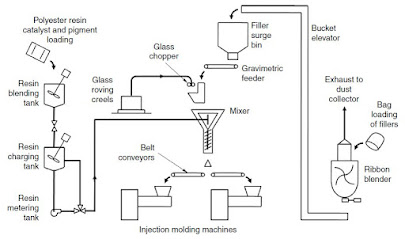
Bulk molding compound (BMC) is a bulky mixture of chopped glass fibers, resin paste, and fillers. Even though other fibers such as sisal, asbestos, carbon, aramid, chopped nylon rag, and wood are used, the most common reinforcing fiber in BMC is E-glass fiber. As BMC is usually mixed in a dough-like form rather than as a sheet, it is also called a dough molding compound (DMC) and is sold in a log or rope form. The resin formulation of BMC materials is similar to SMC materials. Chopped glass fibers are compounded with the resin paste in an intensive mixer and extruded in the form of a continuous log. The extruded log is cut to the desired length by a pneumatic cutter located outside the extruder.


The glass fiber content of BMC is generally 5∼10% lower than that of SMC, and the fibers are shorter (generally less than 25 mm). Therefore, the mechanical properties of BMC are lower than those of SMC. The impact strength is highly dependent on the fiber length. This improvement in the impact resistance by the increase in fiber length becomes less significant above the fiber length of 12.7 mm. Moreover, fiber lengths over 12.7 mm result in mixing and molding problems. Therefore, the fiber lengths of BMC seldom exceed 12.7 mm, and the most common fiber length is 6.23 mm. Sometimes, BMC is mixed at the molding location whereas it also can be purchased from commercial manufacturers that sell the material as a ready-to-mold premix.


This schematic of a continuous compounding system for BMC.


Bibliographical Reference:

Manufacturing Techniques For Polymer Matrix Composites - Page 57


Source:managingcomposites


Monday, January 3, 2022

Danish Prime Minister says country aims to remove fossil fuels from domestic flights by 2030

 Denmark aims to make its domestic flights' fossil fuel-free by the end of the decade, according to its Prime Minister.

In her New Year’s address, Denmark’s Prime Minister Mette Fredriksen announced that she aims to “make flying green” inside the country. Although she acknowledges that the solutions are not yet in place in order to reach this goal, the announcement marks a strong — if not fully official — embracing of this goal.

On a larger scale, Denmark aims to slash its overall carbon emissions by 70% compared to 1990 levels by 2030. Fredriksen’s aim to de-couple internal flights from fossil fuel use would help push the country closer to that goal.


She admits that making domestic flights fully green is no small feat, adding that researchers, as well as transport companies, are working to find solutions.

For example, Airbus, a European airplane manufacturer, has announced plans to have hydrogen-fueled planes operational by 2035. If that hydrogen is generated using renewable energy, it could be one avenue through which Denmark could make good on its goal.

However, it’s not yet clear whether said tech will be ready to use on planes, in a cost-efficient manner, by 2030.


That being said, there is growing international interest in this regard — Sweden has also announced plans to make domestic flights fossil fuel-free by 2030, and international flights by 2045. France is also moving to ban domestic flights on routes where trains would take under two-and-a-half hours to make the same journey.


Researchers and manufactures will surely take this interest into account, and it will help to spur development. For example, there has been some encouraging progress in the field of electric planes, although for now, it remains confined to smaller aircraft.


The air transport sector is a major polluter worldwide. Although domestic flights account for only a small part of its emissions, the smaller distances involved make it a prime area for innovation and development. In time, progress here could make its way on vehicles serving international routes.


Source:ZME Science


Friday, December 31, 2021

Aroma chemicals and the catalyst market

 I have done 2 phone consulting sessions for Fortune500 companies this week. The topics we discussed were Catalyst and Aroma chemicals and their market size, latest trends, Supply chain, and pricing in the global market.

Wish you all a prosperous New year 2022.

Friday, December 24, 2021

Deadly incidents at Indian chemicals plants

 Five dead and at least 15 were injured by explosion and fire at Gujarat Fluorochemicals

Five people were killed and at least 15 others injured during an explosion and subsequent fire at a fluorochemicals plant in the Panchmahal district of Gujarat, India, on 16 December, according to local news reports. The cause of the fatal blast, which was apparently heard several kilometers away, remains undetermined.


Gujarat Fluorochemicals is owned by the Indian conglomerate Inox group. It produces products like fluoropolymers and refrigerants.

An explosion and fire at RP industries in Ankleshwar, Gujarat, on 7 December killed one worker and hospitalized five others; while an incident fire in February at agrochemical maker UPL, also in Gujarat, killed two workers and injured more than two dozen others in February of this year.


Source: Chemistry World


Thursday, December 2, 2021

Spain’s first heavy truck powered by hydrogen is under development

The Basque company Cikautxo, the Tecnalia technology center, and Técnicas Reunidas are leading the first entirely Spanish consortium to launch a truck powered by hydrogen and electricity, capable of carrying up to 40 tons. The project, called SHINEFLEET, is actively working on the decarbonization of road freight transport. For this, technological solutions, based on hydrogen, will be developed to promote intelligent and sustainable mobility of heavy transport fleets in order to replace diesel vehicles.


The truck is expected to be in the testing period in 2023. The challenge is to make this vehicle profitable and weigh as little as possible so as not to reduce load capacity. This initiative will result in a hydrogen fuel cell for trucks, and a modular and compact generation system that combines renewable and blue hydrogen.


The project is structured in three different areas:

– The creation of a new intelligent system for the decentralized production of hydrogen with a low carbon footprint.

– The creation of a tractor head that works with this fuel.

– A system that will allow the entire fleet to be interconnected, thus seeking better communication and navigation of the vehicles.

Together with Tecnalia, Técnicas Reunidas, and Cikautxo, companies such as Avia Ingeniería, Carbotainer, Idneo, Fractalia, and FM Logistic participate, as well as the National Hydrogen Center, the Institute of Chemical Technology, the Autonomous and Complutense Universities of Madrid and Eurecat.


Source: Tecnalia


Wednesday, December 1, 2021

TotalEnergies bets on the production of biomethane for vehicles in Texas

 Through their joint venture, TotalEnergies and Clean Energy are launching the construction of their first biomethane production unit, in Friona, Texas. The biomethane will be used as an alternative fuel for mobility, thus contributing to decarbonizing


road transportation. In March 2021, the two partners set up a 50/50 joint venture to speed up the development of biomethane production in the United States.

Located on the Del Rio Dairy farm, the facility will be fueled by the onsite supply of livestock manure to produce more than 40 GWh of biomethane per year. The fuel will be distributed by Clean Energy through its network of natural gas stations, enabling the supply of biomethane to between 200 and 300 trucks per year.


By processing cow manure, a significant source of methane emissions, and substituting fossil fuels with renewable energies, the project will avoid some 45,000 tons of CO2e emissions per year.

“We are pleased to consolidate our entry into the U.S. biomethane market by jointly developing this first production unit on the Del Rio Dairy farm, through our joint venture with Clean Energy,” said Laurent Wolffsheim, Senior Vice President Green Gases & Growth at TotalEnergies. “This project marks another step in TotalEnergies’ transformation into a multi-energy company, and in the implementation of its ambition to be a major player in renewables.”


“This project at Del Rio Dairy helps to address the increasing demand for renewable natural gas by fleets and is a great example of our partnership with TotalEnergies, one of the world’s leading and most sustainably-minded energy companies,” said Andrew J. Littlefair, president and CEO, Clean Energy. “Renewable natural gas, one of the cleanest fuels on the planet, manages greenhouse gas emissions and tackles global warming. The added production from Del Rio will help us meet our target to provide this 100% negative carbon emissions fuel at all of our North American stations by 2025.”


Source: TotalEnergies


Fraunhofer IWU experts present new materials for additive manufacturing at their self-printed booth

This year’s exhibits at Formnext focuse on materials particularly suited for aerospace applications but so far rarely used in LPBF (Laser Po...