Wednesday, March 11, 2020

Indiana’s largest biogas plant opens, will supply LNG to Midwest fleets

Kinetrex Energy, EDL and South Side Landfill celebrated the completion of the Indy High BTU plant at the Indianapolis South Side Landfill. The plant, which will be fully operational March 20, will convert landfill methane gas into approximately 8 million gallons of pipeline-quality renewable natural gas each year, and in the process, reduce greenhouse gas air emissions in Central Indiana, develop a local renewable resource and lower fuel costs. Indy High BTU is the largest biomethane plant in Indiana.
“This is an exciting day for our city,” said Indianapolis Mayor Joe Hogsett. “We are pleased to see Kinetrex Energy, a homegrown-Indianapolis company, spearheading the effort to provide cleaner, renewable fuel for transportation across the Midwest.”


With construction now complete, Indy High BTU will begin supplying Kinetrex Energy with renewable natural gas, which Kinetrex will turn into LNG and sell to Midwest transportation fleets. Kinetrex recently announced a six-year agreement with UPS to supply the global shipping company with up to 52.5 million gallons of LNG for its Class 8, LNG-powered fleets in Chicago, Toledo, Columbus, St. Louis and Indianapolis.
“Indy High BTU is a major milestone for Kinetrex Energy, our partners and central Indiana,” said Kinetrex Energy President and CEO Aaron Johnson. “The plant strengthens our position as leaders in the creation of renewable fuel and natural gas delivery. The biomethane from the landfill will replace over 8 million gallons of diesel. It is cheaper than diesel and significantly reduces the emission of methane and other greenhouse gases.”
“South Side Landfill has been proactively capturing gas at the landfill for commercial use for more than 30 years, and this is the latest step in reducing emissions to make our city safer and healthier for our residents,” commented South Side Landfill President Mike Balkema.
“We are excited to harness the full potential of renewable natural gas to help decarbonize the transportation industry,” added EDL Head of North American Operations, Central Region, Jim Grant.
Source: Kinetrex Energy

Saturday, March 7, 2020

New flame-resistant thermoset composite for automotive battery packs

IDI Composites International is introducing a new thermoset composite material delivering critical performance benefits for the "new energy vehicles" market.

Deployed in electric vehicle (EV) new energy vehicles (NEV) applications, Flamevex is a flame-resistant lightweight composite. Flamevex has been used on battery packs, which have passed the stringent Chinese Standard GB/T 31467.3 test, commonly known as the China bonfire test. This new thermoset, offers designers a strong, lightweight and cost-effective alternative to steel and aluminum materials traditionally used to enclose battery packs in EVs and NEVs.


EV and NEV designers have long faced the dilemma of balancing flame resistance, strength and light weighting requirements as they develop solutions for critical applications like the vehicle battery enclosure. Battery packs take up significant space in vehicle designs and must offer dimensional strength as well as resistance to flame and high temperatures. Strong and durable, steel has long been a preferred material, but the heavy weight burden makes it a poor choice. While aluminum and carbon fiber provide designers lightweight options, these technologies are still in development stages making them inherently risky and very costly. Flamevex brings to market a thermoset composite technology that is both easy to use and proven in research studies and "on-the road" actual applications.
Yves Longueville, General Manager for IDI Composite Materials (Shanghai) - China said:
"Thermoset composites represent an ideal replacement for metals in these kinds of battery enclosures. Thermoset materials can be formed into complex shapes and they are also strong and lightweight. Beyond these benefits, a high level of fire performance distinguishes Flamevex from traditional SMC composites. Flamevex maintains its impressive fire performance even at low thicknesses, and without compromising the strength or moldability of the compound. It is the best choice for designers developing high performing and affordable products."
Working in collaboration with OEMs and Tier 1 partners, IDI Flamevex materials have been used on battery packs which have passed the Chinese bonfire test—the world's most stringent fire resistance standard—at thicknesses as low as 2.5 mm. Battery packs made with Flamevex also meet the UL 5VA standard. Recognizing that industry standards are continuing to evolve, Flamevex materials can be manufactured to fit specific flame resistance standards for OEMs and Tier 1 manufacturers.
The market for EV and NEV vehicles is growing exponentially, with sales expected to double in 2020, reaching four million new cars globally.
Ramon Rodriguez-Irizarry, IDI Vice President and Group Director of EV Market Development explained:
"As cost of ownership goes down, range increases and emissions requirements become tighter, electric and alternative fuel vehicles are only becoming more attractive to buyers. With Flamevex, we're not only helping to meet a need for OEMs and designers, we're introducing a material that contributes to the strength, safety and affordability of this next generation of vehicles for consumers around the world.
Our vast experience in moldable compounds puts IDI in a unique position to keep pace with the changing landscape of requirements for EV and NEV parts. IDI Composites has worked closely with OEMs and Tier 1 suppliers to meet their flame performance targets and optimize materials to fit the special shapes their newest designs call for. With these composites now in mass production, we look forward to introducing Flamevex SMC to even more manufacturers to help them fulfill their goals for strength, design and safety in not only battery pack covers, but all areas of EV and NEV design."
Source:www.idicomposites.com

4M Carbon Fiber announces a 15% stronger carbon fiber produced 3x faster

In a recent carbon fiber production demonstration, 4M Carbon Fiber announces that it has produced a 15% stronger carbon fiber while tripling production output using their atmospheric plasma oxidation technology..


The results offer industry-disrupting opportunities for carbon fiber manufacturers, demonstrating the ability to produce better carbon fiber while spreading capital and operating costs over three times the production capacity. 4M is exploring ways to license this technology to end users worldwide.
In collaboration with Formosa Plastics Corporation, a commercial carbon fiber producer, and the Department of Energy’s Carbon Fiber Technology Facility at Oak Ridge National Laboratory in Oak Ridge, TN, 4M’s team oxidized Formosa’s precursor using the internationally-patented technology developed by 4M and ORNL. The fiber was then carbonized, surface-treated, and sized at the CFTF. The carbon fiber properties were then tested at the CFTF using industrial testing methodology. The initial trial showed that the fiber exhibits higher tensile properties than carbon fiber produced via conventional technology for that specific precursor.
4M believes that these results enhance 4M’s value proposition by showing that plasma oxidation can positively impact carbon fiber properties.

4M’s next step in the plasma oxidation commercialization process is to complete a $20 million pilot plant to produce samples requested by auto makers, trucking companies, container manufacturers, and carbon fiber producers. The pilot plant should allow 4M to operate closer to commercial scales and produce quantities large enough for carbon fiber manufacturers to make decisions about licensing the technology. The company also anticipates that this pilot plant project will best position it to support building production capacity with partners who license the technology.

Source:WWW.4MIO.COM

Thursday, March 5, 2020

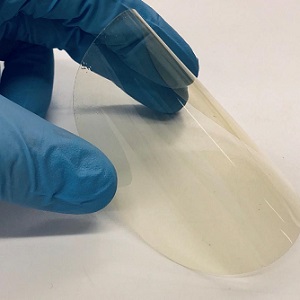
New Transparent Bioplastic with UV Radiation Blocking Property

New Transparent Bioplastic with UV Radiation Blocking Property Researchers at the University of Oulu's research unit of sustainable chemistry have developed a new synthetic and transparent bioplastic that protects from the sun’s ultraviolet radiation.
Biopolymer Made of HMF and Furfural The raw materials used in the biopolymer production are hydroxymethylfurfural (HMF) and furfural, which are biorefinery products derived from cellulose and hemicellulose. By chemically linking them, the researchers were able to create copolymer parts with both bisfuran and furan-like structures. The bisfuran structure of the copolymer effectively prevents UV radiation from passing through a film made from the material. In addition, the airtightness of the material is three to four times that of standard PET plastic. The material can be used in high-tech applications, such as chassis materials for printed electronics. A patent application is filed for this method. Source: University of Oulu

Monday, March 2, 2020

New Technique to Improve Properties of Carbon Nanotube-based Fibers

The Lyding Group has recently developed a technique that can be used to build carbon-nanotube-based fibers by creating chemical crosslinks. The technique improves the electrical and mechanical properties of these materials.

Carbon nanotubes are strong and are very good at conducting heat and electricity. Therefore, these materials have wide applications and can be used as strong fibers, batteries, and transistors,” said Gang Wang, a postdoctoral research associate in the Lyding lab, which is at the Beckman Institute for Advanced Science and Technology at the University of Illinois at Urbana-Champaign.

New Method Based on Linking Individual CNTs Together


There are many ways to build materials that have carbon-nanotube-based fibers. “Airplane wings can be made, for example, by embedding these fibers in a matrix using epoxy. The epoxy acts as a binder and holds the matrix together.” said Joseph Lyding, the Robert C. MacClinchie distinguished professor of electrical and computer engineering and a Beckman faculty member.


However, combining the tubes to make such materials can lead to a loss in important properties. “We came up with a method to bring a lot of that performance back,” Lyding said. “The method is based on linking the individual carbon nanotubes together.

The researchers dispersed brominated hydrocarbon molecules within the nanotube matrix. When heat is applied, the bromine groups detach, and the molecules covalently bond to adjacent nanotubes.

When you pass current though these materials, the resistance to the current is highest at the junctions where the nanotubes touch each other,” Lyding said. “As a result, heat is generated at the junctions and we use that heat to link the nanotubes together.

The treatment is a one-time process. “Once those bonds form, the resistance at the junction drops, and the material cools off. It’s like popcorn going off —once it pops, that’s it,” Lyding said.

The researchers faced many challenges when they were trying to build these materials. “We have to find the right molecules to use and the proper conditions to make those bonds We had to try several times to find the right current and then use the resulting material to build other devices,” Wang said.

The paper is the first step in making a new class of materials. It is likely that the performance will become better because it has not been explored fully yet. The researchers are investigating how strong they can make these materials and improve their electrical conductivity and whether they can replace copper wires with materials that are 10 times lower in weight and have the same performance.
 

Source: Beckman Institute for Advanced Science & Technology
Online Course Recently Added
Natural Fibers - Compounding Best Practices
Reach faster optimal level of performance with your natural fibers by fine-tuning your compounding practices and solving natural fibers limitations with practical tips on pelletizing, screw speed...
106

Thursday, February 13, 2020

New Compostable PLA-based Packaging for Cosmetic Products

Toxicologists have developed a new biodegradable packaging that helps cosmetics firms meet customers’ demand for environmentally friendly packaging at Heriot-Watt University.

The new packaging solves a conundrum for cosmetics firms that currently sell organic, ‘clean’ products in plastic containers made from fossil fuel products that cannot degrade and will forever remain in landfill.


PLA-based New Packaging


The new packaging is made from polylactic acid (PLA), which can be obtained from renewable resources like corn starch or sugar cane and is compostable and biodegradable.

Polylactic acid (PLA) was selected as the plastic for the new packaging, but in order to improve the performance of this plastic, and to increase the shelf life of the cosmetic product, two different materials were incorporated. 

Nano clays and rosemary extract were added as the nano clays improve the barrier properties of the product and rosemary extract acts as an antioxidant to protect the cosmetic product from degradation.

As toxicologists, we know that even natural ingredients like rosemary can be toxic in the right dose. At Heriot-Watt we tested the toxicity of the rosemary extracts and different types of nano clays to select the least toxic candidates for the final product, to ensure it is safe for consumers”, said Dr Helinor Johnston, associate professor of toxicology at Heriot-Watt.

The BioBeauty Project


The BioBeauty project develops bio-packaging, which offers the same environmental credentials as the products it contains. The team believes the new biopackaging has huge potential in the cosmetics market.

The BioBeauty consortium comprised eight partners from five different countries: Spain, Scotland, Slovenia, the Netherlands and France. The partners are ITENE, Heriot-Watt University, Miniland, Alissi Brontë, Alan Coar, Vitiva, Martin Snijder Holding BV and ETS Bugnon. 

Risk Assessment for Potential Harmful Components


Researchers focused on assessing potential harmful impacts on the skin, but also looked at the response of target sites like the liver and immune system. A toxicological profile of the individual components was established along with the assessment of potential risk to the consumer from any migration of the packaging components of the final product. 

We’re creating better ways to test products ethically. As part of this project, we used artificial skin to provide a more comprehensive assessment of how the packaging might react with skin,” said Johnston.

Johnston said “Brands that develop natural and organic products need packaging that aligns with their philosophy and consumer demand for more environmentally-friendly packaging that reduces waste."


Source: Heriot-Watt University


Sunday, February 9, 2020

EFSA Reviews Safe Levels for Five Phthalates in Plastic FCM and Packaging

European Food Safety Authority (EFSA) has issued an update of the risk assessment of the phthalates DBP, BBP, DEHP, DINP and DIDP for use in food contact materials. EFSA reviewed the safe levels for the five phthalates in plastic FCM and evaluated whether current dietary exposure to them posed a concern for public health.


Setting a New Safe Level


EFSA experts have now set a new safe level – a group Tolerable Daily Intake (TDI) – for four of the five phthalates (DBP, BBP, DEHP and DINP) of 50 micrograms per kilogram of body weight (µg/kg bw) per day based on their effects on the reproductive system.

The TDI is an estimate of the amount of a substance that people can ingest daily during their whole life without any appreciable risk to health. The key effect on which this group-TDI is based is a reduction in testosterone in fetuses. The fifth phthalate in the assessment, DIDP, does not affect testosterone levels in fetuses, therefore we set a separate TDI of 150 µg/kg bw per day based on its effects on the liver (as in our 2005 evaluation).

The TDIs are set on a temporary basis due to uncertainties about effects other than the reproductive ones and about the contribution of plastic FCM to overall consumer exposure of phthalates. The experts have identified a need to address these uncertainties by considering the whole body of evidence.

Current Exposure to Phthalates Not a Concern for Health


The current exposure to these five phthalates from food is not a concern for public health. Dietary exposure to the group of DBP, BBP, DEHP and DINP for average consumers is 7 µg/kg bw or seven times below the safe level, while for high consumers it is 12 µg/kg bw, which is four times lower. For DIDP, the dietary exposure for high consumers is 1,500 times below the safe level.

This new assessment of the five phthalates is in line with its 2005 assessment in terms of their most sensitive effects and the individual tolerable daily intakes. The main differences concern an improved estimate of dietary exposure to phthalates and the introduction of the group-TDI for four of the phthalates to account for combined exposure to several phthalates at the same time. This is a common occurrence and confirmed by data from studies with humans, e.g. traces found in urine.


Source: EFSA

Today's KNOWLEDGE Share : Electron Paramagnetic Resonance

Today's KNOWLEDGE Share Electron Paramagnetic Resonance (EPR), also known as Electron Spin Resonance (ESR) , is a spectroscopic techniqu...