Wednesday, July 6, 2011

Applied Nanotech Gets Grant to Develop CNT Reinforced Improved Hydrogen Fuel Tanks for Vehicles

Applied Nanotech Holdings, Inc., has announced that it has been awarded a Phase I SBIR grant, in the amount of $149,426, from the US Department of Energy to develop ultra lightweight hydrogen fuel tanks using carbon nanotube reinforcement.
This grant was awarded for a 9-month program with an overall objective to significantly improve the mechanical properties of the carbon fiber/epoxy material used to construct the hydrogen fuel tanks using carbon nanotube reinforcement. The primary goal is to reduce the weight of the tanks by 20 to 30 percent. A weight reduction of this magnitude will not only significantly lower the hydrogen fuel tank costs but also increase the vehicle's fuel efficiency.
The International Association of Natural Gas Vehicles reported that sales of composite pressure vessels are expected to reach $250 million by 2013, and upwards of $560 million by the end of the decade; the adoption of nanotechnology enhanced resins in high pressure hydrogen storage vessels represents an immense opportunity for near term commercialization. Today, the price of carbon fiber is the main driver of the hydrogen pressure vessel's cost; by incorporating carbon nanotubes into the resin matrix, the resin itself can absorb much of the load currently absorbed by the carbon fiber reinforcement. Using carbon nanotube enhanced resins will undoubtedly decrease the carbon fiber required to construct a functioning hydrogen pressure vessel. The value of this decrease will not only be realized in lower material costs but also in lighter pressure vessels, enabling a more streamlined manufacturing and supply chain process and ultimately a more efficient vehicle.

Applied Nanotech has developed carbon nanotube reinforced epoxies, vinyl esters, and polyesters for carbon fiber and glass fiber reinforced composites. These composites can apply to a wide range of products including: sporting goods, aerospace, automotive, renewable energy, ballistics, and many other applications.
"I am very pleased to see that our nanocomposite technology, first commercialized for sporting goods badminton racquets and golf club shafts with Yonex Corporation, is starting to gain traction in other commercial applications with very large market potential," said Dr. Zvi Yaniv, CEO of Applied Nanotech, Inc.
"Nanocomposite materials are a very important part of our business. We are currently working with a variety of companies across several industries to tailor our composite materials to improve the underlying products of our potential customers," said Doug Baker, CEO of Applied Nanotech Holdings, Inc.

Monday, July 4, 2011

Japan Wool Utilizes SABIC's Flame-retardant PEI Fiber for Blending to Produce Protective Garments

SABIC Innovative Plastics has announced that its versatile, high-performance Ultem* polyetherimide (PEI) fiber has found an important new application in high-end work wear and protective clothing. Japan Wool Textile Company, a division of NIKKE Group, is now blending Ultem fiber with wool and other materials to produce yarn, fabrics and garments that offer a unique combination of comfort and protection, including permanent, non-halogenated flame retardance (FR) and excellent ultraviolet (UV) resistance. Unlike traditional aramid materials, Ultem fiber can be easily and cost-effectively colored in a wide range of shades using conventional polyester dyeing processes, enabling Japan Wool Textile Company to enhance the aesthetic appeal of its new line. SABIC Innovative Plastics continues to penetrate and grow new market segments and expand the range of applications for its globally proven Ultem resin technology to give customers innovative new options for product differentiation and exceptional performance.


"The work wear and protective clothing sector has outgrown traditional materials, and our Ultem fiber offers a significantly better option," said Kim Choate, Global Product Marketing Manager, SABIC Innovative Plastics. "This flexible, soft and colorable fiber provides superior comfort and aesthetics, plus sustainable FR technology and the highest level of protection and durability for workers in safety-focused industries such as oil and gas and chemicals. We foresee many other uses for this versatile fiber, which has already broken new ground in composite aerospace boards for aviation interiors, filtration media and other demanding applications."
"Following a rigorous development process, we launched a completely new flame-retardant material by using Ultem fiber," said Takanobu Matsumoto, General Manager, Japan Wool Textile Company. "Particularly in the areas of improved comfort and colorability, our new work wear products will provide major benefits for customers and address unmet market needs. This SABIC Innovative Plastics technology has also helped us to establish an overseas market for our work wear."
Japan Wool Textile currently offers shirts, trousers, jackets and coveralls in an Ultem fiber-rich blend, as well as yarn and woven fabrics.

Tough on Protection, Easy on the Worker:

Ultem fiber's unique combination of properties fills a longstanding need in the high-end work wear marketplace. Traditional work wear, particularly clothes made from meta-aramids, are stiff and uncomfortable. They also are difficult to dye, thus limiting the ability to produce custom-colored items that support a company's brand. In contrast, Ultem fiber is soft and flexible for improved wearability, and can be dyed in many different colors using existing infrastructure, helping to drive down system costs. It resists degradation from UV light, making the material a potential candidate for outdoor wear.
Ultem fiber is inherently and permanently flame retardant. It utilizes proprietary technology that avoids the addition of environmentally hazardous halogens and cannot wash out of the garment, as many FR agents in low-end fabrics can.
This material offers excellent heat resistance meeting the European Union (EU) EN 531/ISO 11612 and U.S. National Fire and Protection Association (NFPA) 2112 standards, and provides low smoke and toxicity performance.

Friday, July 1, 2011

NJIT Researchers Focus on Making Corn-based Epoxy for Promoting Green Plastics

NJIT Research Professor Mike Jaffe's recent book chapter about sugar-based chemicals is topping the American Chemical Society (ACS) book series' must-read list.
"Sugar-Based Chemicals for Environmentally Sustainable Applications" appeared in the most recent ACS Symposium Series and is racking up kudos. Co-authors were Xianhong Feng, a Doctoral Student and Research Professors A. J. East and W. Hammond, all at NJIT.
The popularity stems from the topic, an overview of isosorbide and its potential role creating polymers and small molecules. The chapter features new and better ways to replace the dreaded bisphenol A (BPA) in manufacturing processes. In 2009, Jaffe's team was awarded a patent for a chemical derived from sugar. The new material uses a corn byproduct, isosorbide, to create a derivative that can be used to replace bisphenol A (BPA) in epoxy resins. Such resins are used in a number of adhesives and coatings of consumer products, including those used in the lining of tin cans. The researchers recently received another patent to compliment the earlier one.
"The new patent will help create a less toxic epoxy resin," said Jaffe. Such resins are polymers widely used as adhesives, paints and coatings to protect food in cans. Jaffe has been developing sugar-based materials in conjunction with the Iowa Corn Promotion Board (ICPB) in an effort to promote and create new, commercially attractive, sustainable chemistries from wider uses of corn. This new sugar derivative can be obtained from corn. The two patents are part of a series filed by the ICPB and NJIT to develop applications and markets for sugar-based chemistry.
"Renewable materials made from corn are gaining ground for new industrial plastics markets," said Rod Williamson, Iowa Corn Director of Research and Business Development. "Making epoxy from corn can be a win-win for public health, plastic manufacturers and for farmers."
Sugar-based chemicals can be used as building blocks to produce new monomers, polymers and additives for the commercial plastics and cosmetics industry. These are materials generally recognized as safe sugar compounds with a unique stereochemistry providing a ubiquitous platform for making cost-effective chemicals and polymers.
The book chapter focuses on isosorbide and its isomers as sugar-derived dianhydrohexitols. The two can be either incorporated in the backbone of new polymers or converted to low molar mass additives for thermoplastics and thermosets or as specialty chemicals. As the cost of petroleum rises, the attractiveness of renewable feedstocks for producing value-added products increases. The emergence of sustainable sugar derived chemicals (especially isosorbide modified products) offers attractive prospects with high potential for the next generation chemical industry.
Much attention has recently focused on BPA, which has been known to have estrogenic properties since the 1930s. BPA is widely used in processes that result in the lining for tin cans and key ingredients in plastics ranging from baby bottles to nail polish. Unfortunately, the chemical bonds that link BPA in polymer structures are not completely stable and the polymer may slowly decay with time, releasing small amounts of it into materials with which it comes into contact, such as food or water. Recent studies have shown the widespread presence of tiny amounts of BPA in the environment. Even at minute levels BPA may still exert estrogen-like effects on living organisms.
The ACS Symposium Series contains high-quality, peer-reviewed books developed from the ACS technical divisions' symposia. Each chapter is carefully authored by an expert in the field, and the collection of chapters edited by an internationally recognized in the field. The series covers a broad range of topics including agricultural and food chemistry, cellulose and renewable materials, chemical education, organic chemistry, polymer chemistry, materials, and many others.

HDPE with Improved Melt Flow Rate Serves to Make Complex Injection-molded Medical Devices

Converters operating in the healthcare market can utilize Bormed™ HE9601-PH high-density polyethylene (HDPE) for high-speed injection-molding applications, such as syringe plungers, caps and closures. This high melt flow rate (MFR=31 which is 2.5-times better than other available options) polymer from Borealis and Borouge gives packaging productivity improvements in medical, pharmaceutical and diagnostic streams.
High flow of HDPE also allows carrying the injection molding process, even for complex designs, easily at relatively lower pressure and temperature, thus giving cost and energy saving advantage to the OEMs. Bormed HE9601-PH is characterized by high stiffness, chemical resistance, barrier performance and impermeability to water vapor, thus making it ideal for use in highly demanding medical and healthcare applications. Bormed HE9601-PH conforms to European and US Pharmacopeia and is registered with Drug Master File.

Tuesday, June 28, 2011

Boeing to boost 737 production rate to 42 airplanes per month in 2014

Boeing Commercial Airplanes President and CEO Jim Albaugh said the market outlook for single-aisle jetliners is strong and growing.

"Customers are demanding our Next-Generation 737 at an unprecedented rate," Albaugh said. "New performance improvements and enhanced passenger comfort features have driven home the value equation for our customers."

Albaugh emphasized the popularity of Boeing's new passenger comfort features, noting that since its introduction in May 2010, the new Boeing Sky Interior is specified on more than 80 percent of new 737 orders.

737 Program Vice President and General Manager Beverly Wyse said the goal with this rate increase is to continue meeting customer demand with an innovative airplane that provides strong performance and value.

"We have worked very closely with our supply chain and our world-class manufacturing team to ensure we can increase rate in an efficient and responsible fashion," Wyse said. "We believe that many of the capital investments and production system changes made for 38 airplanes per month will already position us to build 42," Wyse said. "We are very well situated for this rate increase."

The 737 program currently produces 31.5 airplanes per month and expects to go to 35 per month in early 2012, 38 per month in second quarter 2013, and then to 42 per month in the first half of 2014.

The rate increase announced today is not expected to have a material impact on 2011 financial results.

Boeing's highly efficient and reliable 737 family has become the best-selling airliner in history. More than 280 customers have placed more than 8,880 orders for the single-aisle airplane – including more than 5,750 orders of the Next-Generation 737. Boeing currently manages a backlog of more than 2,100 of the 737 family.

Saturday, June 25, 2011

Opel Astra Selects BASF's PU Glass Encapsulation Technology to Develop Panoramic Windshield

This windshield is quite something. Extending from the hood to the B-pillar, it measures a remarkable 1.5 meters which amounts to more than a third of the vehicle's total length. To give such a large surface sufficient strength, Opel's engineers had to pull out all the development stops a total of eleven patents are now pending. The outcome is nothing less than remarkable. According to the manufacturer, the Panorama GTC is just as strong as the three-door vehicle with a steel roof. One reason for so much light and space is light-stable COLO-FAST® systems from BASF Polyurethanes.

Panorama windscreens of this size are simple to realize with WST technology:

Driving gains a fascinating new dimension with light-stable COLO-FAST systems from BASF Polyurethanes. For decades in applications around the world, they have proven effective as a glass encapsulation material and are in use with almost all leading manufacturers of glass panes and modules. With COLO-FAST WST (Window Spray Technology), BASF now also has an innovative system for pressureless application to glass in an open mold. This flush glazing technology is only possible with polyurethane. The result is glass and panorama roofs with impressively flush seals and glass panes. Bonded or extruded profiles, on the other hand, have considerable design drawbacks and are more susceptible to dirt. WST technology has much more going for it, such as greater design freedom, a reaction time of less than 45 seconds, reduced reworking and ultimately also lower investment costs.

Flush surfaces are the goal of COLO-FAST, WST technology and this not only applies to the automotive industry:

After taking over window encapsulation business from Recticel in 2009, BASF promptly initiated the development of a COLO-FAST® system series in line with the latest requirements of REACH. These systems have been undergoing successful launch in Europe and Asia since the end of 2010.
In addition to the automotive industry, product managers at BASF have also been investigating other growth markets for COLO-FAST WST technology, including the solar industry. The possibility of producing integrated flush photovoltaic panels and solar collectors with it improves water management of the roof, i.e. prevents moisture penetration, and counteracts dirt accumulation by improving rainwater run-off. What's more, COLO-FAST protects the edges of panels and collectors from breakage during shipment and installation.

DSM's ThermoPlastic Copolyester Blow Molding Grade Finds Use in FIAT Automobiles

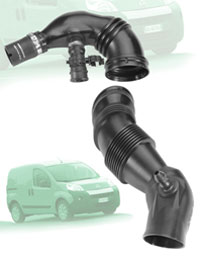
Arnitel PB500-H has been approved for dirty and clean air ducts, assembled on the 1.3 JTD engines for the FIAT Group Automobiles platforms FIAT Minicargo and LANCIA Y (euro V) and for the new LANCIA Y which will be launched in the coming months. Dirty air ducts convey the air before the air filter, whereas clean air ducts are situated in the engine between the air filter and the turbo-compressor.

This new blow molding grade of Arnitel ThermoPlastic Copolyester (TPC) is particularly suited for blow molding of complex shaped air duct applications in the automotive industry for use at continuous use temperatures (CUT) of 130°C. The new material was developed by DSM Engineering Plastics in conjunction with Fiat Group Automobiles and Tier 1 systems supplier Mecaplast.
According to Marco Foresti, who is responsible for CRF Engineering Material Application for Fiat Group Automobiles, Arnitel PB500-H meets the Fiat technical requirements, whilst at the same time offering a cost advantage over current solutions: "With a hardness Shore D equals to 50, Arnitel offers new design freedom and a range of material properties that facilitate easy assembly and higher tolerances on the final design layout."
Ludovic Poix, Fiat Project Manager at Mecaplast, says: "Arnitel PB500-H offers good and stable processability even in achieving complex shapes. The material delivers a superior smooth inner surface with no orange and/or 'crocodile' skin effects. We found it very flexible, over the whole temperature range of -40 ° up to 150 °C. Moreover, Arnitel offers good weldability with PBT fittings/couplings."
Paolo Rossi, Fiat Business Development Manager, explains: "Requirements for Under the Bonnet (UTB) applications are changing constantly. Environmental requirements, EURO V and VI legislation and the call for reduced fuel consumption have resulted in significant changes, e.g. the use of smaller & lighter engines with higher turbo pressures and EGR (Exhaust Gas Recirculation). As a consequence, automobile UTB components such as air ducts are exposed to continuously rising operating temperatures. With increasingly critical temperature and tougher life time requirements, the long term service life of components made from current thermoplastics can be at risk."
Arnitel delivers cost efficient solutions for airducts combining high performance with cost savings through a single piece solution. Arnitel processes faster and lowers weight. DSM Engineering Plastics offers Technical support to Tier-1 to achieve first time right solutions.

SABIC further divests its European Petrochemical (EP) business and its Engineering Thermoplastics (ETP) business in the Americas and Europe

The Saudi Basic Industries Corporation (SABIC) today announced the signing of two strategic transactions to divest its European Petrochemica...