Saturday, June 25, 2011

DSM's ThermoPlastic Copolyester Blow Molding Grade Finds Use in FIAT Automobiles

Arnitel PB500-H has been approved for dirty and clean air ducts, assembled on the 1.3 JTD engines for the FIAT Group Automobiles platforms FIAT Minicargo and LANCIA Y (euro V) and for the new LANCIA Y which will be launched in the coming months. Dirty air ducts convey the air before the air filter, whereas clean air ducts are situated in the engine between the air filter and the turbo-compressor.
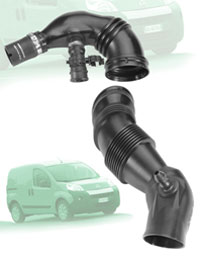
This new blow molding grade of Arnitel ThermoPlastic Copolyester (TPC) is particularly suited for blow molding of complex shaped air duct applications in the automotive industry for use at continuous use temperatures (CUT) of 130°C. The new material was developed by DSM Engineering Plastics in conjunction with Fiat Group Automobiles and Tier 1 systems supplier Mecaplast.
According to Marco Foresti, who is responsible for CRF Engineering Material Application for Fiat Group Automobiles, Arnitel PB500-H meets the Fiat technical requirements, whilst at the same time offering a cost advantage over current solutions: "With a hardness Shore D equals to 50, Arnitel offers new design freedom and a range of material properties that facilitate easy assembly and higher tolerances on the final design layout."
Ludovic Poix, Fiat Project Manager at Mecaplast, says: "Arnitel PB500-H offers good and stable processability even in achieving complex shapes. The material delivers a superior smooth inner surface with no orange and/or 'crocodile' skin effects. We found it very flexible, over the whole temperature range of -40 ° up to 150 °C. Moreover, Arnitel offers good weldability with PBT fittings/couplings."
Paolo Rossi, Fiat Business Development Manager, explains: "Requirements for Under the Bonnet (UTB) applications are changing constantly. Environmental requirements, EURO V and VI legislation and the call for reduced fuel consumption have resulted in significant changes, e.g. the use of smaller & lighter engines with higher turbo pressures and EGR (Exhaust Gas Recirculation). As a consequence, automobile UTB components such as air ducts are exposed to continuously rising operating temperatures. With increasingly critical temperature and tougher life time requirements, the long term service life of components made from current thermoplastics can be at risk."
Arnitel delivers cost efficient solutions for airducts combining high performance with cost savings through a single piece solution. Arnitel processes faster and lowers weight. DSM Engineering Plastics offers Technical support to Tier-1 to achieve first time right solutions.

Thursday, June 23, 2011

Saint-Gobain Introduces PTFE-based Multipurpose Hose for Transferring Corrosive Chemicals

Saint-Gobain Performance Plastics (SGPPL) has introduced a high-performance solution for transferring bulk corrosive chemicals. A superior flexible and kink-resistant hose, Chemfluor® Convoflex™ WCSR Multipurpose Chemical Transfer Hose is designed to solve the issue in bulk chemical transfer process where corrosive chemicals such as acids may damage the stainless steel braid commonly used as a cover on transfer hoses. Saint-Gobain's solution provides a longer service life while enhancing plant and worker safety.


Chemfluor® Convoflex™ WCSR is the newest addition to Saint-Gobain's growing portfolio of versatile critical connections solutions for chemical applications. These solutions are engineered to maintain safety during chemical processes, while reducing total systems cost.
From solvents to bulk chemical transfer, Chemfluor® Convoflex™ WCSR can withstand highly aggressive chemicals during chemical processing. Its highly engineered low profile helical convoluted inner core design provides superior flexibility while maintaining the productivity of plant operations by preventing kinking, a common cause of downtime for such demanding applications.
Chemfluor® Convoflex™ WCSR is constructed with a chemically- resistant, high-purity Chemfluor® PTFE inner core, and is reinforced with 304 high tensile strength stainless steel braids and an acid-resistant Ethylene Propylene Diene Monomer (EPDM) outer-cover. Extremely hard-wearing and durable, the vulcanized EPDM outer cover protects the integrity of the hose when acid or other corrosive chemicals are accidentally exposed to the outer surface.
"We are pleased to introduce this new product to our critical connections solutions portfolio, which is aimed at connecting our customers' processes, operations, and products to what matters to them most: safety, performance, and brand assurance," says Lily Lei, Global Market Leader, Chemicals, Process Systems division at Saint-Gobain Performance Plastics.

Emco Launches Transparent PC Sheets with ASTM F 1915-05 Standard for Security Glazing

Emco Plastics is one of the leading distributors of monolithic, UV, and abrasion resistant security glazing material that conform to ASTM F 1915-05 standards. Made from polycarbonate, the 3/8" thick material meets the level 4 requirements, while the 1/2" thick material meets the level 3 requirements. This product provides 90% light transmission and may be used for banks, convenience stores and courtroom security windows as well as prison glazing. These sheets resist physical attack and vandalism.
Emco Plastics, is one of the industry leaders in distribution and fabrication of industrial plastic products offers several types of security glazing that comply with ASTM F 1915-05 standards.

Saturday, June 11, 2011

Copolyester-based Beer Tubes for Restaurants and Bars

Beer Tubes™ is a BPA-free and good looking barware and a beverage dispenser made using Eastman Tritan™ copolyester, which is known for its clarity, toughness, and heat & chemical resistance.
This tabletop beverage dispenser featuring sports or non-sports-themed base can be commercially used in restaurants and bars or home for individual use. The 100-ounce Beer Tube and 128-ounce Super Tube, along with commercial taps are copolyester-based, and are available in more than 25 designs. The product was previously manufactured using polycarbonate, but Beer Tubes™ later switched to Eastman copolyester which does not fade away after repeated contact with dishwashing detergents.

PEEK Bioimplants Synchronize Well with Human Anatomy

Minimally invasive spinal implants supplier Apollo Spine Inc. from California has received FDA’s go ahead for its new Eclipse-L® vertebral interbody lumbar spacer and Eclipse-C® vertebral interbody cervical spacer made of Solvay Advanced Polymers’ Zeniva® polyetheretherketone (PEEK) resin. Zeniva PEEK biomaterial features modulus close to that of bone, and is used in replacement of metals such as titanium. The hollow implants grow through the device, and get fused with the nearby bony surfaces for easy movement. Available in various ranges of sizes, shapes and diameters, the implants grow in synergy with the natural human anatomy.
Exhibiting great strength, stiffness and radiolucent properties for X-ray treatments, the PEEK biomaterial used in rods and stocks are manufactured in compliance with ISO 13485. Besides Zeniva PEEK, the Solviva Biomaterials range also includes Proniva® self-reinforced polyphenylene thermoplastic; Veriva® polyphenylsulfone provides transparency and biocompatibility; and Eviva® polysulfone (PSU), another transparent polymer.

Friday, May 20, 2011

Mercedes Selects BASF's Semi-aromatic Polyamide for its Fuel Filler Flap

The current T-model in the E-Class from Mercedes has an especially large fuel filler flap, since it is intended to accommodate variable fueling options. This flap has recently been converted to the new Ultramid® TOP 4000 from BASF, a mineral-filled semi-aromatic polyamide (PA 6/6T). The conductive engineering resin is an improved version of the Ultramid TOP 3000 introduced in 2007 and offers primarily greater stiffness and dimensional stability. Just like its predecessor, the new material is also suitable for online painting.

This means: plastic components made from Ultramid TOP 4000 can, without additional effort or costs, withstand the various baths and painting operations to which the rest of the body is subjected. This material thus represents one more step towards the lightweight plastic automobile body thus enabling further reduction of fuel consumption and emissions.
In the course of development, the BASF Verbund once again demonstrated its capabilities, as the experts at BASF Coatings GmbH in Münster contributed greatly to optimizing the new resins on the basis of their know-how in the fields of paint and coating. The fuel filler flap for the Daimler station wagon is manufactured at Kunststoff Schwanden AG in Schwanden (CH).

Tuesday, May 17, 2011

India: Delhi’s buses may run on renewable fuels

As a joint venture with the Swedish government, Delhi plans to convert biogas generated at Keshopur sewage treatment plant to CNG. The fuel will be used to power buses owned by the Delhi Transport Corporation (DTC). Headed by the local Efficiency and Renewable Energy Management Centre, it is the first such initiative undertaken in the country and is expected to begin by September this year.

Last Friday, Swedish experts made a final presentation before Delhi’s Environment department, and the project has been in principle approved. According to Indian Express, Delhi government will get 50 per cent of funding from Swedish Development Corporation Agency and will support the rest of the cost.

Delhi began talks with the Swedish government last December, when Swedish experts completed a three-month study of four sewage treatment plants in Delhi (Dwarka, Keshopur, Coronation Park and Okhla).

“If Keshopur project is successful, we will replicate it in all 17 plants of the Capital. This will be able to meet the CNG requirement for a major portion of the DTC fleet,” said a senior official.

Today's KNOWLEDGE Share : Understanding Draft Angles in Injection Molding

Today's KNOWLEDGE Share 💡 Understanding Draft Angles in Injection Molding — Small Detail, Big Impact When designing plastic parts, dra...