Sunday, January 30, 2022

Ultralight eco-friendly carbon-fiber surfboard fins?

 It's time for our segment Endless Possibilities!


Ultralight eco-friendly carbon-fiber surfboard fins?


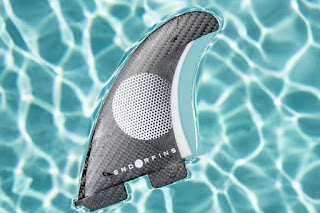
Designed by @Firewire Surfboards, the "Endorfins" is designed to be screwed into the fin box to secure the base of the fin and allow the carbon flex patterns to truly come to life. In addition, the fins are also designed to float so they can be retrieved from the ocean if needed. Each set is built with a base that is compatible with either FCSII or Futures boxes.


The FCSII compatible base will require two screws that will come with the fins. Endorfins with FCSII compatible bases will not click in and click out. Combining that knowledge, and several rounds of testing and adjusting over the past year and a half, they are excited to present Endorfins to the world.


The design of these fins is the culmination of many years and extensive experience with a variety of designs and templates. This unique flex pattern is created by a carbon twill, layered with an ultralight carbon veil over a PET core. The PET core is majority air resulting in fins so light they float on water.


Source: JEC Composites

#managingcomposites

Friday, January 28, 2022

JOB VACANCY

 JOB VACANCY

My client is looking for a Production Manager having experience in the production of Acrylic acid/maleic acid copolymer and other similar polymers.


Salary: Based on your expertise and best in the market


Location: Maharashtra (India)

Visit MY BLOG http://polymerguru.blogspot.com

Monday, January 24, 2022

Michael Faraday Electric motor Invention

 Michael Faraday invented electric motors in 1821 and built this model of his electric motor in 1822.


On 3 September 1821, Faraday observed the circular rotation of a wire as it was attracted and repelled by magnetic poles. He sketched in his notebook a clockwise rotation around the south pole of the magnet, and the reverse around the north pole. "Very satisfactory," he wrote in his entry on the day's experiment, "but make more sensible apparatus."

Faraday continued experimenting into the fall of 1831, this time with a permanent magnet. He discovered that he could produce a constant current by rotating a copper disk between the two poles of a permanent magnet. This was the first dynamo and the direct ancestor of truly useful electric motors.


Credit: IEEE

WOVEN CARBON FIBER COMPOSITE

 📢Microscopic Mondays!📢


Today we have another microscopy that looks like modern art!


This picture shows a post-tear/delamination of a woven carbon fiber composite sample! It was taken using a darkfield mode that delivers high contrast and enables viewing the half section of the delaminated composite ply, providing unique insights on the distribution of the epoxy within the sample!


Beautiful isn't it? 😍


Source: ZEISS

#managingcomposites


Monday, January 17, 2022

TYPE 4 COMPOSITE CNG CYLINDER PROJECT

 I prepared a project report for the TYPE 4 Composite CNG cylinder project for a Multinational company for their entry into the Gas storage system this year.

I have been invited to present it to the board of directors in the next few weeks.


Thursday, January 13, 2022

China will try to achieve the first carbon-neutral Olympics

 There will be a spectrum of climate-friendly strategies being used throughout the winter games.

China will be making its best attempt at holding a carbon-neutral Olympics as it deploys a range of different types of renewable energy, among other strategies it is adopting for the Winter games in Beijing.


Renewable energy, including solar and wind from Zhangjiakou, will provide much of the games’ power.

Zhangjiakou is located about 100 miles northwest of the host city of Beijing. Its terrain and weather make it one of the country’s best resources for solar and wind energy production. As such, it is somewhat of an unofficial co-host to what is aiming to be the first carbon-neutral Olympics. That region’s renewables comprise about half its electricity output, even though only about a third of the full 70-gigawatt potential has been installed so far.


China intends to make this the greenest winter games that have ever been held. Beijing intends to use renewables to power all 26 of its venues, which will be a first in history. The Beijing 2022 Organising Committee is hopeful that it will achieve its CO2 neutrality level, but the mission overall is to come as close as possible. This will set a benchmark for the International Olympic Committee as it pursues its 2024 goal for climate positive games.

In 2020, President Xi Jinping announced that the country was embarking on an ambitious goal to achieve CO2 neutrality by 2060. This makes the 2022 carbon-neutral Olympics in Beijing a strong opportunity to drive and spotlight sustainable development in the region. The winter games have already helped the host city to achieve improved air quality and environmental conditions. Moreover, it has launched substantial local energy-tech markets.

The event and the global attention it draws are providing China with the perfect opportunity to showcase its alternative transportation, energy efficiency, and new refrigeration technologies. Beyond demonstrating the country’s moves toward its climate goals, the cutting-edge tech-using ice venues are meant to help the area to establish itself as a world-class green sports tourism destination.

Carbon-neutral Olympics in Beijing would represent a tiny fraction of the country’s energy challenges.

If the winter games in Beijing do become the first carbon-neutral Olympics in history, it will certainly be a noteworthy achievement, but will be only a drop in China’s energy challenges pond. The games will account for only a miniscule fraction of the annual electricity demands within the country.

When taking China’s massive renewable capacity into account, it won’t be too much of a stretch for the games to be powered by clean energy, according to University of California, San Diego engineering systems and global-policy expert Michael Davidson. That said, Davidson went on to underscore that the country’s infrastructure is inadequate for managing intermittent renewables. Furthermore, electricity-dispatch practices there don’t place a priority on renewable energy. As a result, much of the clean energy capacity in China is frequently left unused.


It should also be pointed out that as the game venues for the hoped-for carbon-neutral Olympics are connected to the standard power grid, energy will be provided by a range of sources, not all of which are green. Therefore, said Davidson in an IEEE Spectrum report, being able to confidently say that the CO2 targets were met during the winter games would be “complicated.”

Still, what the games are managing to do as they take aim at becoming the first carbon-neutral Olympics is to raise green energy’s profile and draw attention to its potential.

“The hope is that this process will put into place some institutions that could help leverage a much broader-scale move to green,” said Davidson.


Source:www.hydrogenfuelnews.com
BMW Group and ENGEL Develop Functional Auto. Components in Cleanroom Atmosphere

 The BMW Group has launched a new ENGEL production unit at its Landshut production plant. The kidney-shaped badge for the electric BMW iX is produced in a cleanroom atmosphere. Both the BMW Group and ENGEL are breaking completely new ground here, prompting the International Society for Plastics Technology (SPE Central Europe) to honor the application with the SPE Grand Award 2021.


Kidney-Shaped Badge for Assisted Autonomous Driving


Once the radiator grille, this characteristic design feature of all BMW models have taken on a new role following electrification of the drivetrains. The kidney-shaped badge protects the camera as well as several sensors for assisted and, in the future, autonomous driving. The new function means that both the design and the manufacturing process for the kidney-shaped badge have changed fundamentally.

In an integrated process, a heat-able functional film is back-molded with polycarbonate and flood-coated with polyurethane. This is a combination of processes that is also offered by ENGEL under the name clearmelt. "We knew from the start that this process combination would enable automotive designers to think in a completely new way," says Michael Fischer, head of business development technologies at ENGEL AUSTRIA. "With the technology already having been used for vehicle interiors, the kidney-shaped badges for BMW's new electric models represent the next step. This is the first time that combined film back injection molding and polyurethane flooding is being used in the series production of functional components on the exterior, where they are exposed to particularly high stress.”

The sensitive electronics are well protected under the scratch-resistant polyurethane surface. The high gloss level and depth effect, which even a thin coating of polyurethane achieves, convey a very elegant impression.

ENGEL’s Systems for Demanding Project


ENGEL is system supplier for this demanding project, with responsibility for the complete production cell. In terms of process integration and automation, it meets particularly high requirements.

The production cell integrates an ENGEL duo combi M injection molding machine with a horizontal rotary table, two large articulated robots for handling the films and molded parts, a film cleaning system, an inline quality-control station and peripheral units including polyurethane technology. The injection molding machine's clamping unit and the robot work areas are encapsulated over a length of six meters and a height of more than four meters to achieve an ISO class 7 cleanroom. The special feature: Above the injection molding machine, the cleanroom has a sliding ceiling that can be opened for mold changes and other work in the mold area. All work steps in the cleanroom are automated. The robots also unpack the function films and pack the parts.

An ISO class 8 greyroom adjoins the cleanroom with the production cell. This is the work area for the production employees who transfer the airtight boxes with the function films to the cleanroom production system and the packed molded parts to intralogistics for downstream processing.

Virtual Visualization Ensures Future-proof Production


Another first: ENGEL virtually visualized the entire production unit as early as in the RFQ phase. "In the 3D simulation, we were able to guide our customer through all the production cell areas, see how the robots interact, and assess the ergonomic aspects before construction of the cell had even begun," as Walter Aumayr, vice president automation and peripheral Units at ENGEL AUSTRIA report. "This is the future. Virtual reality means that we can give our customers even better investment security."

As the system solution provider, ENGEL is the central contact for customers, also for system components realized in conjunction with partners. Partner companies for the production cell for the BMW's new kidney-shaped badges include Hennecke from St. Augustin, Germany, for polyurethane processing, and Petek Reinraumtechnik from Radolfzell, Germany, for cleanroom technology.

Source: ENGEL

Thursday, January 6, 2022

Bulk molding compound (BMC)-Time to Get Technical

 📢Time to Get Technical...📢


Let's learn more about BMC's! 👀


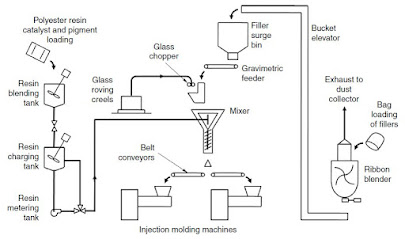
Bulk molding compound (BMC) is a bulky mixture of chopped glass fibers, resin paste, and fillers. Even though other fibers such as sisal, asbestos, carbon, aramid, chopped nylon rag, and wood are used, the most common reinforcing fiber in BMC is E-glass fiber. As BMC is usually mixed in a dough-like form rather than as a sheet, it is also called a dough molding compound (DMC) and is sold in a log or rope form. The resin formulation of BMC materials is similar to SMC materials. Chopped glass fibers are compounded with the resin paste in an intensive mixer and extruded in the form of a continuous log. The extruded log is cut to the desired length by a pneumatic cutter located outside the extruder.


The glass fiber content of BMC is generally 5∼10% lower than that of SMC, and the fibers are shorter (generally less than 25 mm). Therefore, the mechanical properties of BMC are lower than those of SMC. The impact strength is highly dependent on the fiber length. This improvement in the impact resistance by the increase in fiber length becomes less significant above the fiber length of 12.7 mm. Moreover, fiber lengths over 12.7 mm result in mixing and molding problems. Therefore, the fiber lengths of BMC seldom exceed 12.7 mm, and the most common fiber length is 6.23 mm. Sometimes, BMC is mixed at the molding location whereas it also can be purchased from commercial manufacturers that sell the material as a ready-to-mold premix.


This schematic of a continuous compounding system for BMC.


Bibliographical Reference:

Manufacturing Techniques For Polymer Matrix Composites - Page 57


Source:managingcomposites


Monday, January 3, 2022

Danish Prime Minister says country aims to remove fossil fuels from domestic flights by 2030

 Denmark aims to make its domestic flights' fossil fuel-free by the end of the decade, according to its Prime Minister.

In her New Year’s address, Denmark’s Prime Minister Mette Fredriksen announced that she aims to “make flying green” inside the country. Although she acknowledges that the solutions are not yet in place in order to reach this goal, the announcement marks a strong — if not fully official — embracing of this goal.

On a larger scale, Denmark aims to slash its overall carbon emissions by 70% compared to 1990 levels by 2030. Fredriksen’s aim to de-couple internal flights from fossil fuel use would help push the country closer to that goal.


She admits that making domestic flights fully green is no small feat, adding that researchers, as well as transport companies, are working to find solutions.

For example, Airbus, a European airplane manufacturer, has announced plans to have hydrogen-fueled planes operational by 2035. If that hydrogen is generated using renewable energy, it could be one avenue through which Denmark could make good on its goal.

However, it’s not yet clear whether said tech will be ready to use on planes, in a cost-efficient manner, by 2030.


That being said, there is growing international interest in this regard — Sweden has also announced plans to make domestic flights fossil fuel-free by 2030, and international flights by 2045. France is also moving to ban domestic flights on routes where trains would take under two-and-a-half hours to make the same journey.


Researchers and manufactures will surely take this interest into account, and it will help to spur development. For example, there has been some encouraging progress in the field of electric planes, although for now, it remains confined to smaller aircraft.


The air transport sector is a major polluter worldwide. Although domestic flights account for only a small part of its emissions, the smaller distances involved make it a prime area for innovation and development. In time, progress here could make its way on vehicles serving international routes.


Source:ZME Science


Continuous Marketing leads you taste more profits

If your marketing team is being forced to justify every single action by ROI or ROAS, you're strangling your own growth. The biggest dri...