Posts

Phillips 66 announces major milestone in production of renewable diesel
Image
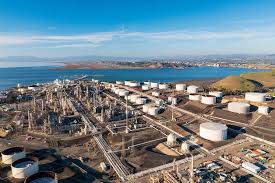
Phillips 66 has announced a major milestone in its conversion of the San Francisco refinery into the Rodeo Renewable Energy Complex - expanding commercial scale production of renewable diesel. The Rodeo Renewed project has progressed, with the facility now processing only renewable feedstocks and producing approximately 30,000 barrels per day of renewable diesel. The Rodeo Renewable Energy Complex is on track to increase production rates to more than 800 million gallons per year (50,000 bpd) of renewable fuels by the end of the second quarter, positioning Phillips 66 as a leader in renewable fuels. “We are proud to announce this significant achievement at our Rodeo facility,” said Rich Harbison, Phillips 66 executive vice president of Refining. “The project advances Phillips 66’s long-held strategy to expand our renewable fuels production, lower our carbon footprint, and provide reliable, affordable energy while creating long-term value for our shareholders.” Harbison added: “We’ve had...

Today's KNOWLEDGE Share:Bacteria Strain to plastic Biodegradable

Image
Today's KNOWLEDGE Share New Bacteria Strain that Makes Plastic Highly Biodegradable and Fracture Resistant Engineered bacteria can produce a plastic modifier that makes renewably sourced plastic more processable, more fracture resistant and highly biodegradable even in sea water. The Kobe University development provides a platform for the industrial-scale, tunable production of a material that holds great potential for turning the plastic industry green. Bacterial Plastic Factory Produces LAHB Chains in High Amounts: Plastic is a hallmark of our civilization. It is a family of highly formable (hence the name), versatile and durable materials, most of which are also persistent in nature and therefore a significant source of pollution. Moreover, many plastics are produced from crude oil, a non-renewable resource. Engineers and researchers worldwide are searching for alternatives, but none have been found that exhibit the same advantages as conventional plastics while avoiding their p...

China’s first hydrogen-powered city train conducts high-speed tests

Image
Developed by Changchun Railway Vehicles, a subsidiary of Chinese state-owned rolling stock manufacturer CRRC, China’s first hydrogen energy urban train ran a trial run in Changchun, Jilin province, reaching a full load operating speed of 160 kilometers per hour. The hydrogen energy train uses 35 MPa – 165 L hydrogen storage cylinder sets produced by Sinoma Suzhou, a subsidiary of Sinoma Technology. This train adopts a distributed hybrid power supply solution with multiple energy storage and multiple hydrogen energy systems, and applies the hydrogen-electric hybrid energy management strategy and control system.  “Each hydrogen energy urban train is equipped with 4 systems. Each system is composed of two 165 L hydrogen storage cylinders. The hydrogen storage capacity of 8 cylinders of 165 L reaches 31 kilograms“, Li Shihong, senior engineer of Sinoma Suzhou, said. Hydrogen energy urban trains use an energy supply method that combines hydrogen fuel cells and supercapacitors to replace...

Today's KNOWLEDGE Share:Tiger Stripes

Image
Today's KNOWLEDGE Share Any surface particle on a molded part used to belong to the Fountain Flow free surface. Free surfaces for a visco-elastic material typically suffer from flow instabilities, and these end-up creating surface defects on your molded part. High front velocity and especially flow front acceleration/deceleration will trigger flow instabilities and defects. This is why the gate area and the end of flow (see picture) are so prone to surface defects. We do have the highest velocity at the gate and a potential extreme velocity at the end of flow (or slowdown due to switchover). "Tiger Stripes" are a well known defect due to Fountain Flow instabilities triggered by a change of flowfront speed. source:Vito leo

Today's KNOWLEDGE Share: A fully recycled composite bicycle bottle cage

Image
Today's KNOWLEDGE Share A fully recycled composite bicycle bottle cage! Swancor and the Taiwanese brand Massload have jointly developed bicycle parts, a bicycle bottle cage highlighted in particular, crafted entirely from recycled composite materials." "The low-carbon bottle cage, which weighs only 17 grams, has undergone a year of rigorous testing and validation. It blends 50% of Swancor’s recycled carbon fiber with 50% recycled polyamide 6 (PA6) pellets, manufactured through an injection process. The companies anticipate commencing mass production of this environmentally friendly solution in the first quarter of 2024, with help from Massload, which has extensive know-how in supplying components to global bicycle brands." "Swancor’s own expertise has contributed to the bicycle bottle cage’s development. The company has been actively promoting the use of recycled materials, alongside the development of its recyclable thermosetting resin EzCiclo and CleaVER degra...

Toyo Ink India to Boost Solvent-based Adhesives Production in Gujarat

Image
Toyo Ink India, a member of the Japan-based chemicals manufacturer artience group (formerly Toyo Ink Group), announces plans to expand its production capacity for solvent-based adhesives at its manufacturing site in Gujarat, India. Meet Market Demands: A new production facility will be built on-site at the Gujarat plant as part of the expansion to meet rising local demand. The plant is slated to begin operations in April 2026 and will help to boost the Gujarat site’s adhesive capacity by 3.5 times its current output. In 2014, Toyo Ink India began importing adhesives from Japan and selling them to the local market for automotive interiors and has over the years expanded applications to home appliances and labels. In December 2021, a production operation was established in India, Gujarat, enabling the company to more promptly respond to customer needs and to further grow its business. As demand from these markets grew, the capacity for adhesive production became tight, leading to the dec...

Orion Set to Produce Conductive Additives for Batteries at Texas Plant

Image
Orion broke ground on a plant in Texas that will be the only facility in the U.S. producing acetylene-based conductive additives. These additives will be for lithium-ion batteries and other applications vital for the global shift to electrification. Producing Additives having One-tenth of Carbon Footprint: The site in the city of La Porte, southeast of Houston, will create many high-skilled jobs, both in construction and technical fields and bring innovative technology to the American economy. The battery additives produced by Orion’s plant will be super clean, with only one-tenth of the carbon footprint of other commonly used materials. “Orion is already the sole producer of acetylene-based conductive additives in Europe,” Orion CEO Corning Painter said at the groundbreaking ceremony. “Our plant in La Porte will be a pivotal step toward strengthening the regional supply of conductive additives in the rapidly growing U.S. battery market.” Every battery requires conductive additives...