Thursday, April 11, 2024

CO2-negative construction thanks to new composite material

A new composite material is finding its way into the construction industry. Made from natural stone, carbon fibers and biochar, it is an alternative to reinforced concrete. It is characterized by a particularly good CO2 balance.

The DITF is leading the joint project “DACCUS-Pre*”. The basic idea of the project is to develop a new building material that stores carbon in the long term and removes more CO2 from the atmosphere than is emitted during its production.       
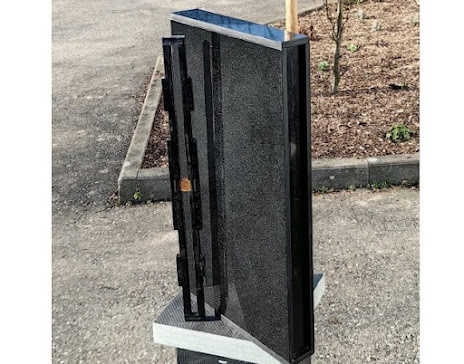


In collaboration with the company TechnoCarbon Technologies, the project is now well advanced – a first demonstrator in the form of a house wall element has been realized. It consists of three materials: Natural stone, carbon fibers and biochar. Each component contributes in a different way to the negative CO2 balance of the material:


Two slabs of natural stone form the exposed walls of the wall element. The mechanical processing of the material, i.e. sawing in stone cutting machines, produces significant quantities of stone dust. This is very reactive due to its large specific surface area. Silicate weathering of the rock dust permanently binds a large amount of CO2 from the atmosphere.


Carbon fibers in the form of technical fabrics reinforce the side walls of the wall elements. They absorb tensile forces and are intended to stabilize the building material in the same way as reinforcing steel in concrete. The carbon fibers used are bio-based, produced from biomass. Lignin-based carbon fibers, which have long been technically optimized at DITF Denkendorf, are particularly suitable for this application: They are inexpensive due to low raw material costs and have a high carbon yield. In addition, unlike reinforcing steel, they are not susceptible to oxidation and therefore last much longer. Although carbon fibers are more energy-intensive to produce than steel, as used in reinforced concrete, only a small amount is needed for use in building materials. As a result, the energy and CO2 balance is much better than for reinforced concrete. By using solar heat and biomass to produce the carbon fibers and the weathering of the stone dust, the CO2 balance of the new building material is actually negative, making it possible to construct CO2-negative buildings.


The third component of the new building material is biochar. This is used as a filler between the two rock slabs. The char acts as an effective insulating material. It is also a permanent source of CO2 storage, which plays a significant role in the CO2 balance of the entire wall element.


Cover photo: DITF /jeccomposites

Wednesday, April 10, 2024

Today's KNOWLEDGE Share:Flow induced nucleation and more crystallinity

Today's KNOWLEDGE Share

Injection Molding creates non-monotonic crystallinity gradients through the thickness, and corresponding non monotonic elastic modulus.


On one hand the rapid quench of the skin (combined with fountain flow) reduces crystallinity of the most outer layers leading to typically half the nominal modulus ( PP data).

The high shear just below (frozen skin) will produce strong "flow induced nucleation" and more crystallinity ( and oriented structures). These layers can be 4X stiffer than the skin in PP.
Finally the core section undergoes a more quiescent crystallization with slower cooling and shear rates and will have "average" crystallinity, larger non-oriented crystals and pretty much the data-sheet kind of modulus .

source:Vito leo

CJ Biomaterials' PHA Used for Fully Biodegradable Plastic Bottle Cap by Beyond Plastic

 CJ Biomaterials, Inc, continues to expand the applications for its advanced PHA technology, announcing that their biopolymers are being used by California-based Beyond Plastic to develop the world’s first completely biodegradable plastic bottle cap. CJ Biomaterials is a division of South Korea-based CJ CheilJedang and a primary producer of polyhydroxyalkanoates (PHA) biopolymers.


Both Recyclable and Compostable:

We are proud to be working with Beyond Plastic to help make this innovative solution a reality. These PHA-based bottle caps not only address the pressing environmental concerns associated with traditional plastic caps, but also demonstrate the versatility and effectiveness of our PHA technology in delivering sustainable alternatives,” says Max Senechal, chief commercial officer at CJ Biomaterials. “We remain committed to advancing eco-friendly solutions that contribute to a healthier, more sustainable planet.

Derived from nature and produced sustainably, CJ Biomaterials’ biopolymers serve as building blocks to improve functional characteristics of traditional plastics. They offer a range of environmental benefits. PHAs work well as modifiers to other polymers or biopolymers and serve to increase bio-based content, accelerate biodegradation, and improve the functional properties of resins and finished products. As one of the industry players capable of mass-producing PHA, CJ Biomaterials is committed to impactful action. It delivers more sustainable solutions with its extensive PHA technology platform.

With the inclusion of CJ Biomaterials’ PHA, the Beyond Plastic bottle cap is both recyclable and compostable, in addition to being fully biodegradable.

Utilizing CJ Biomaterials’ PHA biopolymers, we’ve developed an authentically eco-conscious alternative to conventional plastic bottle caps. This marks a significant leap forward in sustainability, but it’s just the beginning,” Fred Pinczuk, Beyond Plastic’s chief technology officer explained, saying that Beyond Plastic has an ongoing focus on facilitating manufacturers’ adaptation of equipment to seamlessly incorporate PHA. “Our aim is to offer tailored PHA formulations for diverse applications, such as straws, caps, and various single-use plastics currently threatening our environment. Once the process is streamlined, it will catalyze a profound transformation within the industry.

PHA-based Polybag with Properties Similar to Petroleum-based Polybags:

CJ Biomaterials began producing its PHACT™-branded PHA biopolymers in 2022. Since that time, the company has partnered with multiple organizations to develop innovative solutions using its PHA technology. The introduction of the PHA-based plastic cap is just the latest application announced by CJ Biomaterials. Earlier this year, the company introduced a PHA-based polybag with properties similar to traditional petroleum-based polybags.

The technology was also used in the development of microwaveable paper coating used in New Today’s Chicken Noodle Cup packaging, sold at CU, South Korea’s convenience store chain. The company also works with NatureWorks to broaden the use of PHACT™ PHA combined with Ingeo™ PLA in multiple markets and applications.

Source: CJ Biomaterials/Omnexus.specialchem


Milliken to Unveil Two New Solutions for PP and PE at NPE 2024

Milliken & Company will bring its full range of additive and colorant solutions for polypropylene (PP) and polyethylene (PE) plastics to NPE 2024.


Milliken joins industry leaders for the expo to explore novel and sustainable pathways for plastics, enabled in part by the company’s comprehensive polymer additive portfolio.


Opportunity to Collaborate with Plastics Value Chain:

Milliken works across the value chain to enable PP and PE formulations that make plastics more reusable, recyclable, and efficient without sacrificing performance. With a range of clarifier and nucleator agents, masterbatches, polymeric colorants, and viscosity and performance modifiers, Milliken’s portfolio helps its customers and brand owners achieve their own sustainability goals.


“We look forward to NPE, as it’s an exciting opportunity to collaborate with the entire plastics value chain under one roof,” shares Milliken’s global vice president for Plastic Additives Wim Van de Velde. “Milliken offers a suite of performance-driven, sustainability enhancing products that support manufacturing and brand trends and help solve circularity challenges to make plastics a material of choice.”


At NPE 2024, Milliken will unveil two new solutions—Milliken UltraGuard 2.0 and Hyperform HPN 58ei. “NPE 2024 attendees will have a first look at two Milliken additive launches, with far-reaching sustainability benefits,” adds Van de Velde. “These two new additives join our portfolio centered on making smarter plastics.”


Delivering New Solutions for Optical Performance

The latest UltraGuard 2.0 solution builds on our longstanding line of tailored masterbatches for PE to improve barrier performance in HDPE and LLDPE by up to 70%—subsequently supporting more mono-material packaging options and material downgauging.


Hyperform HPN 58ei enhances performance for PP sheets and thermoformed parts to deliver improved optical performance, isotropic shrinkage and regrind quality and is FDA-approved for food packaging. Visitors can visit Milliken’s booth throughout NPE to learn more about these two products.


Complementing its overarching approach to responsible manufacturing processes and in alignment with the company’s 2025 Sustainability Goals and its near- and long-term net-zero targets, Milliken develops products that support its customers’ sustainability goals.


Reducing Resource Consumption and Solving Circularity:

Milliken partners with the value chain to create purposeful additive solutions that reduce resource consumption, enhance health and well-being, and solve circularity and end-of-life challenges. Solutions include:


Source: Milliken/www.specialchem.com


 Want to know more about business opportunities in Polymer Composites Cylinder manufacturing??

Want to understand how to set up a Type4 H2 Cylinder manufacturing plant??
Join me on April 24th, 10AM-12.30PM IST at IIT Gandhinagar, Gujarat.  I will be hosting a workshop on Type 4 Hydrogen Cylinder manufacturing and sharing my experiences, and also address challenges in the liner and overwrapping cylinders manufacturing process, material selection, future of the hydrogen economy, etc. 
Don't forget to be there, you can register here https://lnkd.in/d2dbcra3

Look forward to seeing you at this workshop, let's connect, and build a clean energy future together!


#polymers #polymerscience #composites #plasticsindustry #hydrogen #compositematerials #manufacturing #hydrogeneconomy#storagetank #india #cgd #pipeline #natural gas #gas #greenhydrogen #electrolysers #ccus #alternativeenergy  #renewableenergy #environmental #cleanenergy #netzero #carbonfiber

Monday, April 8, 2024

Today's KNOWLEDGE Share : Hengshen’s carbon fibre materials are used in a 143-meter-long wind turbine

Today's KNOWLEDGE Share

Hengshen’s carbon fibre materials are used in a 143-meter-long wind turbine blade.The blade is 143 meters long and has an impeller diameter of 292 meters. It is one of the wind turbine blades with the largest impeller diameter in the world. 


The carbon fibre fabric used in this blade is exclusively supplied by China’s Hengshen which has annual production capacity of 5,000 tons of carbon fibre. The product portfolio covers raw silk, carbon fibre, sizing agents, fabrics, liquid resins, adhesives, prepregs, carbon fibre composite parts, and aviation composite structural parts. 

In 2021, Hengshen’s 24K carbon fibre, fabric and carbon plate products obtained DNV certification from the international authoritative certification agency, becoming the first domestic carbon fibre unit to obtain this certification. Up to now, Hengshen has supplied products such as carbon fibre pultruded sheets and warp-knitted fabrics in batches to domestic and foreign wind turbine manufacturers such as Envision Energy, Shanghai Electric, and Mingyang Smart Energy.


source: Hengshen/hscarbonfibre.com/jeccomposites.com


Tuesday, April 2, 2024

Today's KNOWLEDGE Share:Mold Deformation

Today's KNOWLEDGE Share

Do you realize how deformable your mold can be ?

Years ago I measured the mold plate deflection under a packing pressure of 80 MPa (that is 800 bar or less than 12000 psi) , for a simple two plate, robust, stainless steel plate mold. We found that the bending accounted for 20 microns equivalent increase in cavity thickness. Over the original 2mm cavity thickness, this is a whole 1 %, more than the typical shrinkage of a nicely packed PC. But the amazing finding, based on FEA computations of the mold metal structure itself, is that about 1/3 of this increase was due to steel compressibility !

So, even in the remote (actually impossible) case your mold would be very very stiff, the cavity would still grow bigger during pack because of STEEL COMPRESSIBILITY !


source:Vito leo

Today's KNOWLEDGE Share : Electron Paramagnetic Resonance

Today's KNOWLEDGE Share Electron Paramagnetic Resonance (EPR), also known as Electron Spin Resonance (ESR) , is a spectroscopic techniqu...