Wednesday, July 25, 2018

BASF Further Develops Hydrolysis-resistant Polyesters for Automotive Industry

The demand of the automotive industry for highly effective sensors for the expansion of electric mobility and autonomous driving is increasing. So BASF has further developed its range of hydrolysis-resistant thermoplastic polyesters.
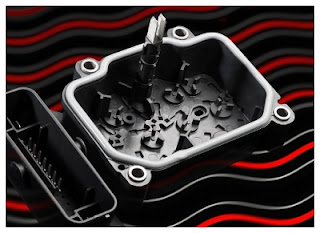
Expanded Range of Ultradur® HR

The expanded range of Ultradur® HR (HR= hydrolysis resistant) comprises Ultradur® B4330 G6 HR High Speed, a particularly flowable and laser markable grade with 30% glass-fiber reinforcement, Ultradur® B4330 G10 HR, a highly reinforced grade with 50% glass fibers as well as Ultradur® B4331 G6 HR, the next generation with optimized processing characteristics. Ultradur® B4331 G6 HR is available from now on as uncolored grade, in a black laser markable version, and in orange for components in electric cars.


Highly Resistant PBT Materials


With its Ultradur® HR grades, BASF offers highly resistant PBT materials (PBT= polybutylene terephthalate) which are especially suitable for use in challenging environments. They thus enable a long service life and an excellent operational reliability of automotive components. The HR grades also have a considerably increased resistance to alkaline media which trigger stress corrosion cracking.

This is also true of the new Ultradur® B4331 G6 HR grade with considerably improved melt stability and flowability. In tests, Ultradur® B4331 G6 HR does not display any increase in viscosity even with long residence times and at high temperatures - the best basis for stable and easy processing. The material can also be colored in orange (RAL 2003) in order to produce high-voltage plug-in connectors for electric cars. Thanks to the unusually high tracking resistance for PBT, the plug-in connectors can be designed smaller and still withstand the higher voltages in electric vehicles. Thus savings on costs and component weight are possible.

Laser-markable Grade

The Ultradur® 4330 G6 HR series which is already available with 30% glass-fiber reinforcement has been expanded to include the particularly flowable and laser-markable Ultradur® B4330 G6 HR High Speed bk15045. With this grade, thin-walled parts and components which show a high ratio of flow path to wall thickness can easily be produced.

The new Ultradur® B4330 G10 HR is filled with 50% glass fibers. It can therefore be processed to components which are simultaneously exposed to moisture and high temperatures (160°C, short term up to 180°C) and keep a high stiffness, e.g. steering modules in the charge air duct. In the temperature range from 140°C to 180°C, the material reaches almost the property level of polyphenylene sulfide (PPS), which is usually employed in this kind of applications.

Developed for Selected Automotive Applications

For selected automotive applications BASF has developed Ultradur® B4450 G5 HR. The PBT is reinforced with 25% glass fibers, RoHS-compliant and flame retardant. It can be colored in light colors and laser-printed. With its low fogging values according to the VDA 278 emission test, it is suitable for applications in car interiors and also for housings of control units.

The newly developed material combines hydrolysis resistance with flame retardancy, high tracking resistance and low smoke density. This property profile is also aimed at electric vehicles with their considerable safety requirements and much higher currents than in conventional drive trains.

Since the market launch, BASF has developed around a dozen HR-modified Ultradur® grades, with 15%, 30% and 50% glass-fiber reinforcement, particularly flowable, impact-modified, laser markable, laser transparent or flame-retardant. Typical applications can be found primarily in automotive electronics, e.g. housings of control units, connectors, sensors, but also charging plugs, housings of battery stacks or connectors in the high-voltage circuit of electric cars.

Source: BASF


INEOS Styrolution’s SAN Grades Earn Chinese National GB Food Contact Accreditation

INEOS Styrolution has announced that two of its Luran styrene acrylonitrile copolymers (SAN) grades, Luran SAN C 552495 and Luran SAN C NR, are in compliance with GB 4806.6-2016 (Chinese National Food Safety Standard on Food-Contact Use of Plastic Resins), the additives used are cleared under GB 9685-2016 (Chinese National Food Safety Standard on Use of Additives in Food Contact Materials and Articles). These grades are also compliant with USA Food and Drug Administration (FDA) and European Union (EU) food contact regulations.


SAN Plastic Compliant with Food Contact Regulations

Key Points

Material of Choice for Processing, Design & Safety

  • The Luran product line from INEOS Styrolution provides outstanding surface quality, excellent transparency and food contact compliance, enabling the creation of products that are aesthetically pleasant, durable and safe for daily household use. 
  • Luran SAN C 552495 and Luran SAN C NR exhibit well-balanced property profiles, good chemical resistance and superior processability for demanding injection molding applications. 
  • The low residual monomer levels exhibited in these two grades is also the result of an upgrading project completed in 2017 at INEOS Styrolution’s SAN production lines in Map Ta Phut, Thailand, bringing on the advantage of improved food contact safety, particularly for the household industry, which requires food contact compliance for their finished products.

A Versatile & Cost-effective Solution

  • A trusted material with excellent property retention, INEOS Styrolution’s various Luran grades are currently used in various household applications such as water filters, mixers and blenders, cosmetics jars and coffee machine water containers.

Advance Application Innovation in Household Industry


Sven Riechers, Vice President, Specialties Business Management, Asia Pacific, INEOS Styrolution, said:
“With the increasing tightening of plastic food contact safety compliance regulations globally, INEOS Styrolution collaborates closely with our partners to continuously renew, improve and differentiate our portfolio and services to generate further value for our customers in the household industry. We are currently working on the other grades in our food contact range to achieve compliance with Chinese National GB food contact regulations.”
 
Source: INEOS Styrolution

Monday, July 16, 2018

Avantium Opens Pilot Biorefinery for Plant-based Chemicals Production

Avantium had announced that it will officially open a pilot biorefinery in Delfzijl, Netherlands next month. Opening ceremonies took place in Amsterdam on 10 July and in Delfzijl will take place on 13 July.

Avantium’s Novel Technologies:

Avantium develops novel technologies that uses renewable carbon sources instead of fossil resources, such as DAWN Technology. It aims to make the most efficient use of biomass and eliminating waste streams. All biomass constituents are separated into a range of products and the goal is to get the greatest possible value out of these products. This is called cascading. 

DAWN Technology is an innovative process that converts plant-based non-food feedstock to high purity industrial sugars and lignin. The industrial sugars are used in chemistry and fermentation processes to produce a broad range of durable materials, while lignin is used in energy generation. 


Dawn Technology’s Products:

The DAWN Technology biorefinery produces three main product streams: 

1. Glucose: DAWN Technology is differentiated from other technologies in its ability to produce high purity glucose. There is no source of high purity glucose from non-food, plant-based feedstock commercially available today. 

2. Mixed sugars: In addition to glucose, the mixed sugar stream contains a number of other valuable sugars such as xylose, mannose and galactose. Mixed sugars are suitable as feedstock for fermentation processes used to make products such as ethanol, vitamins and acetic acid. 

3. Lignin: Lignin is the compound that is left once the sugars have been taken out of the original raw material. It is more efficient for energy generation as its energy content is up to 40% higher than the original wood chips used in the process. Energy generation is currently the predominant 
application for lignin. Additional higher value applications are being developed. 

The technology uses acid to selectively separate the sugar streams from the feedstock material (i.e. the agricultural or forestry residues). Avantium’s proprietary inventions reduce water consumption by 70% with significantly reduced energy consumption. This not only manages the environmental footprint of the process but also improves the cost profile of the resulting products. 

The objective of the pilot biorefinery is to scale up the technology, validate the economics, and further optimize the technology and application development. 

The Core Building Block


Glucose is a core building block for many industrial products and is increasingly important in the transition towards a bio-based economy. All materials made from petroleum today (examples are bottles, t-shirts and carpets) can be replaced with materials made from glucose. This would reduce reliance on petroleum, mitigate carbon dioxide (CO2) emissions and help tackle climate change. Today, glucose is predominantly produced from food sources such as corn, wheat, sugar beet and sugar cane. 

DAWN Technology unlocks the glucose available in non-food agricultural and forestry residues such as wood chips, wheat straw or corn stover. 

Transitioning towards Circular Economy


Tom van Aken, Chief Executive Officer of Avantium, said: “We are thrilled to open our pilot biorefinery, which will enable the use of non-food biomass, such as forestry residue, to make many products people use every day. This is a milestone in our work to support the transition to a circular economy, and we are already looking beyond the pilot phase. We have a consortium of partners committed to developing a commercial-scale plant.”
Forestry residues plant avantium
Avantium's Biorefinery will use forestry residue to produce 
useful products

Right Partners Tapping into Expertise


Avantium previously announced it had founded a consortium to develop an ecosystem for the biorefinery technology. The consortium consists of AkzoNobel, RWE, Staatsbosbeheer and Chemport Europe, each of which brings specific expertise for the planned commercial scale bio-refinery.

“We have gathered the right partners to tap into local expertise, utilities and infrastructure for the future commercial scale-up of our technology in the Netherlands,” said Van Aken. “Other potential partners around the world have also expressed interest in licensing our technology for local deployment, to make glucose from a wide variety of feedstocks.”

Replacing Petroleum Products


Gert-Jan Gruter, Chief Technology Officer of Avantium, said: “Glucose is a core building block for the transition towards a bio-based economy. We can replace all materials made from petroleum today with materials made from glucose. Our technology makes optimal use of already available agricultural and forestry residues.”
Patrick Brouns, regional minister of the province of Groningen, said: “We are happy to welcome Avantium to Delfzijl. They bring innovation, green chemistry and highly skilled jobs to the region and fit well with the existing local chemistry, energy and agricultural sectors “We are happy to welcome Avantium to Delfzijl. They bring innovation, green chemistry and highly skilled jobs to the region and fit well with the existing local chemistry, energy and agricultural sectors and the knowledge institutions. With Chemport Europe we also support the future commercialscale biorefinery in Delfzijl.” 

Source: Avantium

Sunday, July 15, 2018

Business Growth in Polymer Industry via Problem Solving; OCT 2-4, Atlanta


This UN-RIVALED course attended by 500+ participants is designed to help those involved in the following functions:

• Technical Service / Trouble Shooting in Polymer Industry
• R&D & Processing-Polymers
• Analytical Services

Below we present some examples:

• EXAMPLE #1of 50+: During occasional longer breaks, the extruder froze resulting in lengthy tear-downs & cleaning, thus adversely affecting the productivity. "Melt-Polycondensation" was established as the root-cause. Rather than changing the “near Impossible” manufacturing process for the problem-polymer, a change in lubricant system with an unexpected catalytic effect, solved the problem. The Case-History leading to $10M+ in preserved business will be discussed including technical fundamentals & product development.

• EXAMPLE #2 of 50+: Fine particle CALCIUM CARBONATE is a popular filler for polyolefins and PVC and it has to be coated with stearic acid (SA). More than a monolayer coating can lead to extruder die-lip build up and especially adhesion problems. Following a customer driven project, a ToF-SIMS investigation in 2008 revealed that the “Desired-Bound SA” was chemically reacted on the surface of CaCO3 which allowed us to quantify & reduce/eliminate the undesirable “Un-Bound SA”; thus resulting in better product development and cost savings resulting from usage of lesser SA additive.

EXAMPLE #3 of 50+: Challenged by a sale at stake led to the discovery of reactor induced memory in NYLONS after 50 years of their existence. This led to a proliferation of ideas for technical marketing; signing of a $37M/year contract being just one outcome !
……………………………………………………..
For details, please contact Innoplast Solutions at (973) 801-6212 or visit
http://innoplastsolutions.com/courses/polymer-failure-defects.html
Atlanta-Downtown, USA, October 2-4, 2018
$300 Discount Ends AUGUST 2nd

Thursday, July 5, 2018

ANTIBACTERIAL PLASTIC SHEET HAS BEEN INSTALLED IN ENDOSCOPY CABIN IN INDIA

Antibacterial plastic sheet has been installed successfully in Endoscopy cabin in a well known hospital in India.It is another milestone in penetrating into the market where only conventional methods/process has been widely encouraged so far.

Now i have started getting orders for Hospitals now.I started this project in 2004 and have partnered with an European manufacturer in 2009 and here in 2018, after passing our samples in various countries for different applications and now we are getting orders slowly.

We have reached this level with the help of my indomitable will thru out all these years.

Monday, June 25, 2018

TITAN®53: new gas module features world’s largest composite cylinders

Hexagon has unveiled a new Mobile Pipeline® gas transport module, the TITAN®53, which employs the largest composite cylinder tanks in the world. After nearly a decade of success with TITAN® products, customers are requiring the ability to move greater volumes of compressed gases including natural gas, hydrogen and industrial gases.

The newly developed cylinders and 53-foot-long module optimize weight and capacity to meet the 80,000 lbs GVW limit in most of the United States delivering an estimated gas volume of 492,000 scf / 13,932 scm.


The TITAN®53 at delivers almost 40% greater payload while retaining all the advantages of the TITAN® platform. Applications for TITAN®53 include energy intensive industries converting to natural gas, virtual interconnects, gas islands, vehicle refueling, and transporting industrial gases.

The TITAN®53 is the most recent example of how Hexagon is adapting leading composite pressure vessel technology for a wide range of applications for CNG, hydrogen, propane and industrial gases.
Hexagon has experience building fuel solutions for rockets, locomotives, ships, and vehicles. Hexagon’s Mobile Pipeline® also provides transportation, storage and distribution solutions. Over 1,100 units of Mobile Pipeline® modules have been successfully deployed around the world through 2017.

Source: Hexagon


Saturday, June 23, 2018

Avantium to Build Bio-MEG Demonstration Plant in Netherlands

Avantium has started construction of a new demonstration plant that will help advance the production of bio-based alternative mono-ethylene glycol (MEG) made directly from renewable sugars.

Environmentally Friendly Plant-based Alternative:

As MEG is a component for making everyday consumer goods, such as PET and PEF plastics and polyester textiles, the development of an environmentally friendly plant-based alternative has strong potential. Today, more than 99% of MEG is produced from fossil resources and the market demand for this product is expected to grow from 28 million to 50 million tons in the next 20 years.


Novel Single-step Process

“Our novel single-step process can finally fulfil this demand in an environmentally sustainable manner that both consumers and leading brands have been seeking. I am proud of our team for making this important technological breakthrough. This enables renewable products growth for consumers that increasingly demand products brought to them in a responsible manner,” said Tom van Aken, Chief Executive Officer of Avantium.

New Plant to be Operational in 2019

The new plant will use Avantium’s pioneering Mekong technology to convert renewable sugars into bio-based MEG. The plant – part of a previously disclosed €15-20 million investment in our most advanced technologies – will be operational in 2019, employing up to 20 people.
Alongside this important investment decision by Avantium, the European Innovation Council has selected the Mekong technology as part of its €146 million investment in top-class innovators, entrepreneurs, small companies and scientists with bright ideas and the ambition to scale up internationally. “We are honored to be selected among the 79 innovative projects following face-to-face interviews with a jury of innovators, entrepreneurs and venture capitalists,” said Van Aken.

Novel Bio-MEG Technology

The objectives of the demonstration plant are to scale up the novel bio-MEG technology, validate the technical and economic feasibility of the process, and to collect data to execute an environmental life-cycle analysis (LCA) quantifying the sustainability benefits of the Avantium technology.
“This is a major step forward in the development of our Mekong technology,” said Zanna McFerson, Chief Business Development Officer of Avantium. “In addition to the environmental benefits, this demonstration plant will replicate commercial scale conditions of producing cost-effective bio-MEG; a drop-in product identical to the fossil-derived product."

"We are exploring partnership opportunities in bringing this technology to full-scale commercialization globally.” In parallel to this new development, Avantium is nearing completion of a biorefinery pilot plant for its Zambezi technology that produces high-purity glucose and lignin from non-food biomass. This biorefinery is located in Delfzijl, the Netherlands.


Source: Avantium

Sunday's THOUGHTFUL POST : THE “BENT KEY PRINCIPLE”

 🔑 THE “BENT KEY PRINCIPLE” How a Tiny Mistake Inside Toyota’s Factory Created One of the Most Powerful Ideas in Modern Business In the ear...