Tuesday, February 6, 2024

Today's KNOWLEDGE Share:Mycelium Composites

Today's KNOWLEDGE Share

Mushroom-derived materials could offer benefits for developing nations in Africa

A research team from the University of Bristol has suggested that mycelium composites could offer a sustainable alternative to traditional building materials and help address socio-economic and environmental challenges in Africa.


Mycelium composites are a class of materials based on mycelium – the roots of mushrooms. These versatile materials, which have gained popularity in Europe and the US in the past decade, are produced by harnessing the ability of fungi to grow by feeding on organic biomass – eliminating the need for high-end manufacturing processes. In fact, mycelium composites can be grown almost anywhere – even at home – without the need for extensive expertise or advanced equipment.


The organic biomass used for the basis of mycelium composites are often obtained from agricultural, agro-industrial, and forestry waste streams. There is a wide range of applications for mycelium composites, including packaging materials, insulation panels, floor tiles, and furniture.


Mycelium composites are also envisioned as the ‘next-generation of self-healing and self-growing’ structures in construction. This can be achieved due to the ability of fungi to respond to light, chemicals, gases, gravity, electric fields, and mechanical cues.


Stefania’s paper suggests mycelium composites can add value to agricultural waste, potentially offering an incentive for investment in the agricultural sector and increasing productivity. Mycelium composite production could also serve as a greener waste management route not only for agricultural waste, but for plastics and other carbon-based waste materials too.

The next step for the authors is to fine-tune the properties and production of mycelium composites in order to facilitate the integration of this technology with well-established practices in diverse developing countries.


source:bristol.ac.uk/jeccomposites

Single proton illuminates perovskite nanocrystals-based transmissive thin scintillators

National University of Singapore (NUS) researchers have developed a transmissive thin scintillator using perovskite nanocrystals, designed for real-time tracking and counting of single protons. The exceptional sensitivity is attributed to biexcitonic radiative emission generated through proton-induced upconversion and impact ionisation.

The detection of energetic particles plays an important role in advancing science and technology in various fields, ranging from fundamental physics to quantum technology, deep space exploration and proton cancer therapy. The increasing demand for precise dose control in proton therapy has fuelled extensive research into proton detectors. One promising approach to enable proton counting during radiotherapy involves the development of high-performance thin-film detectors that are transmissive to protons.


Despite advancements in silicon-based, chemical vapour deposition, diamond-based, and other types of proton detectors in recent years, a fundamental challenge remains unresolved: achieving real-time proton irradiation with single-proton counting accuracy. In single-proton detection, the detectable signal is fundamentally limited by the thickness of the detector. Therefore, a proton-transmissive detector must be fabricated at an ultrathin thickness while retaining sensitivity for single-proton detection. Existing particle detectors, such as ionisation chambers, silicon-based detectors and single-crystal scintillators, are too bulky to allow the transmission of protons. Additionally, organic plastic scintillators suffer from low scintillation yields and low particle radiation tolerances due to their low electron density, which hampers their single-proton detection sensitivity.


A research team led by Professor LIU Xiaogang from the Department of Chemistry and Associate Professor Andrew BETTIOL from the Department of Physics, NUS demonstrated the real-time detection and counting of single protons using thin-film transmissive scintillators made of CsPbBr3 nanocrystals. This approach offers unparalleled sensitivity with a light yield approximately double that of commercially available BC-400 plastic thin-film scintillators and ten times greater than conventional bulk scintillators such as LYSO:Ce, BGO and YAG:Ce crystals.


Their findings have been published in the journal Nature Materials.


The thin-film nanocrystal scintillators, with a thickness of approximately 5 µm, exhibit high sensitivity that allows for a detection limit of 7 protons per second. This sensitivity is about five orders of magnitude lower than clinically relevant counting rates, making it a significant advancement in single-proton detection technology.


source:The Graphene Council

Arkema Expands its Global Production Capacity for Elastomers by 40%

Arkema has increased its global manufacturing capacity for Pebax® elastomers by 40% at its Serquigny plant in France. This expansion supports its customers’ strong growth, in particular in the sports and consumer goods markets.


Used in Sports Equipments, Electronic and Medical Devices:

Arkema has started its new Pebax® elastomer unit at the Serquigny plant in France. This new unit is designed with the latest advancements in industrial processes. It can produce both the bio-circular Pebax® Rnew® and classical Pebax® elastomer ranges.


These advanced materials are used in sports equipment such as running shoes, soccer shoes and ski boots. Other uses are in electronic devices, and specialty markets such as antistatic additives and medical devices.


"We are excited to start the production of this expansion in our Pebax® elastomers capacity. This represents a great opportunity for us to meet growing demand in existing and new applications while simultaneously improving our processes as water consumption at the site will be reduced by approximately 25%," said Erwoan Pezron, senior vice-president of Arkema's High Performance Polymers Business Line.


Source: Arkema/omnexus.spcialchem

Monday, February 5, 2024

TotalEnergies Produces Circular Polymers by Recycling Feedstocks from Plastic Waste

TotalEnergies converts feedstocks from plastic waste into circular polymers at its polypropylene plant in La Porte, Texas.


The La Porte plant is one of the world's largest polypropylene sites. It will produce sustainably certified polymers. These polymers will be suitable for a wide range of applications, including food grade packaging.


Patented Pyrolysis Technology Processes Mixed Plastic Waste

The petrochemical feedstock was provided by New Hope Energy's ISCC+ certified advanced recycling facility in Tyler, Texas. The feedstock was converted into monomers at the BASF TotalEnergies Petrochemicals (BTP) facility. It is a 60/40 joint venture between BASF and TotalEnergies. BTP facility is based in Port Arthur, Texas. The monomers were then transformed into circular polymers at TotalEnergies' plant in La Porte, Texas. Both the La Porte and BTP facilities received their ISCC+ certification in 2022.


TotalEnergies and New Hope Energy have also signed a multi-year agreement. Under this agreement, New Hope Energy will supply TotalEnergies with petrochemical feedstock made from plastics to produce recycled polymers. New Hope Energy uses a patented pyrolysis technology developed in partnership with Lummus Technology. It processes and converts mixed plastic waste that would otherwise end up in landfill or incineration.


"After Europe, this first production of circular polymers from advanced recycling in the United States is a new step forward in our commitment to meeting the global market's growing demand for more innovative and sustainable plastics, as well as in our ambition to produce one million tons of circular polymers a year by 2030," said Heather Tomas, vice president Polymers Americas.


"We are excited to partner with TotalEnergies in our mutual effort to transform plastic for a cleaner world," said Rusty Combs, chief executive officer of New Hope Energy. "This supply agreement is an important step towards achieving New Hope's goal of creating pyrolysis projects at a scale that will materially improve the nation's plastic recycling performance. We are honored by the confidence TotalEnergies has placed in both our team and our robust technology."


Source: TotalEnergies/omnexus.specialchem


Today's KNOWLEDGE Share:PEEK FOR HIGH PRESSURE SEALS

Today's KNOWLEDGE Share

3 REASONS YOU SHOULD CONSIDER PEEK FOR HIGH PRESSURE POLYMER SEALS

1.STRENGTH:

PEEK seals can withstand pressures up to 30 ksi (207 MPa). This is due to PEEK’s combination of high strength and high modulus. 

The three different grades of PEEK: Virgin PEEK,30% Glass fiber reinforced PEEK, and 30% Carbon fiber reinforced PEEK.

Tensile Strength: 14 ksi,18.9 ksi, 31 ksi

Tensile Modulus:507 ksi,1600 ksi,3050 ksi


2.OPERATING TEMPERATURE:

High pressure applications often go hand in hand with extreme temperatures. Fortunately, PEEK offers a wide operating temperature range. It works for cryogenic applications down to -100°F and still retains its key mechanical properties in temperatures up to 450°F. 


3.CHEMICAL RESISTANCE:

Another reason for PEEK’s popularity in high-pressure applications involves its chemical resistance. Many times these same high-pressure environments involve harsh or caustic chemicals that can compromise the physical properties of even the most outstanding polymers. PEEK, on the other hand, can retain its strength even in the presence of harsh chemicals with just a few exceptions.


PEEK’s combination of strength and stiffness makes it a prime choice for high pressure applications, but when that is combined with its resistance to chemical attack and operating temperature range, PEEK quickly begins to stand out as a first choice for high pressure polymer seals. Combine that with its resistance to both wear and creep, and PEEK is definitely a winner when it comes to intense, demanding seal applications. 


source:Advanced EMC technologies

Sunday, February 4, 2024

Today's KNOWLEDGE Share:High and low shear rate changes in Rheology

Today's KNOWLEDGE Share

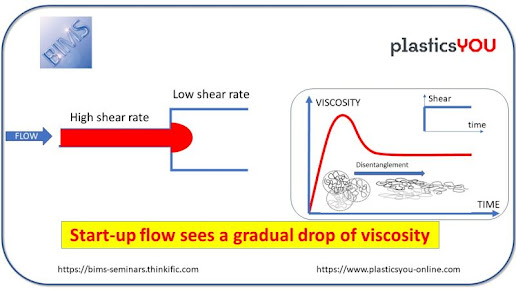
If a relatively high Mw grade flows from thin to thick, as shown in the picture, and if the time needed to fill the thick section is way shorter than the average polymer relaxation time, the polymer will not be able to reach its higher viscosity (corresponding to higher thickness/lower shear-rate). I am assuming here the polymer reached equilibrium low viscosity in the thin section, say for instance because it is much longer.


Any pressure prediction not accounting for transient rheology would then overpredict the pressure to fill.Of course the diverging flow will further complicate the situation and mess with the molecular orientation created in the thin section, but to what extent ?


Since this is more of a reasonable "conjecture", don't take this for granted, and discuss or share your opinion in the comments.

There are hundreds of Rheology papers on the "4:1 contraction flow".

Not sure I have ever seen any on the..."1:4 expansion flow" !


source:Vito leo


Saturday, February 3, 2024

Covestro Develops High Heat Resistant Copolycarbonate for Medical Industry

Overmolding polycarbonate with liquid silicone rubber (LSR) is commonly used to produce respiratory masks and other medical devices requiring molded-in seals. Now, Covestro has developed Apec® 2045 – a copolycarbonate with the highest heat resistance. It enables molders and medical OEMs to significantly slash production time and cost. This does not sacrifice quality, performance or appearance.


Supports Close- and Open-loop Recycling:

"We work closely with our healthcare customers and recognized that we could offer a polycarbonate made for highest curing temperatures in silicone over-molding, helping them more than double production volumes in the same amount of time due to shorter cycle times," said Pierre Moulinie, Global Healthcare Technology lead, Covestro LLC.


Apec® 2045 copolycarbonate also offers other important benefits for this market. These include:


Durability: Tough engineering plastic with the highest heat resistance in the medical polycarbonate portfolio

Transparency: Produces transparent parts with high optical clarity

Biocompatible: Biocompatibility testing according to ISO 10993-1 and USP Class VI for contact of 30 days or less

Sterilizable: Supports sterilization methods most prevalent in the healthcare industry, including irradiation, autoclave and hot air

Processability: Consistent and efficient processing


Using this new material may help customers meet sustainability goals. It enables circular business models by supporting close- and open-loop recycling. It also allows for the possibility of attributed bio-circular content.


Attendees at MD&M West, February 6-8 in Anaheim, California, can visit the Covestro booth (#2221). There they can learn how Covestro's materials push boundaries in healthcare applications.


Polycarbonates from Covestro are found in some of modern technology’s most essential medical devices. They play a major role in developing next-generation, life-saving technology. These exemplify the innovation, safety and biocompatibility known and trusted worldwide. This is because they are used where strength, clarity and toughness are necessary.


"Our experts provide support every step of the way," he continued, “helping our customers calculate possible savings when switching to this new high-heat Apec® copolycarbonate grade – for example, simulating material performance in specific applications and calculating cost benefits with our LSR calculator tool.”


Souce:Covestro/omnexus.specialchem

Faerch advances circular packaging leadership with growing rPET volumes from Cirrec

As many recyclers across Europe face significant market pressures and operational challenges, Faerch’s integrated recycling facility, Cirrec...